


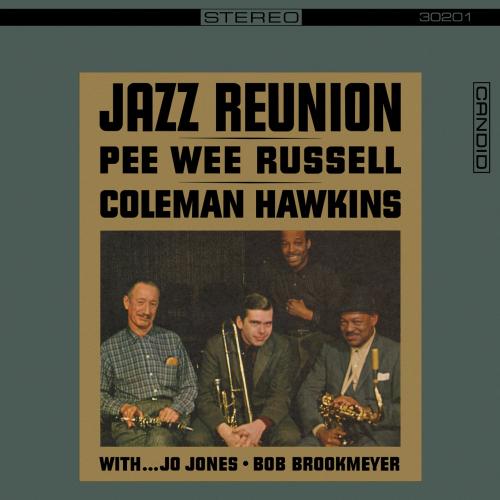
Jazz Reunion (Remastered) Pee Wee Russell & Coleman Hawkins
Album info
Album-Release:
2022
HRA-Release:
05.03.2026
Album including Album cover
- 1 If I Could Be With You (One Hour Tonight) (Remastered) 06:31
- 2 Tin Tin Deo (Remastered) 08:57
- 3 Mariooch (Remastered) 07:21
- 4 All Too Soon (Remastered) 07:36
- 5 28th And 8th (Remastered) 07:26
- 6 What Am I Here For? (Remastered) 07:49
Info for Jazz Reunion (Remastered)
This superb recording features a reunion of two of jazz's finest - tenor-saxophonist Coleman Hawkins and clarinetist Pee Wee Russell. At the time of this session, the two had not been on a recording date together in 32 years. Here they revisit If Could Be With You One Hour, a song they first recorded in a classic version back in 1929.
Pee Wee Russell, though often mistakenly associated only with Dixieland jazz, defied classification. His unorthodox playing and highly individualistic and spontaneous clarinet style pushed boundaries.
Coleman Hawkins is almost unanimously considered to be one of the first prominent saxophonists of jazz. While he came up with swing during the big band era, he had a crucial role in the development of bebop in the 1940s. And by the 1960s he was considered a jazz patriarch.
Here Hawkins and Russell, two unique and distinct legends, and at the time of this recording already elder statesman of jazz, stretch out on two Duke Ellington tunes, two originals by Russell, and the standard Tin Tin Deo.
Produced by Candid Records A&R man and founder Nat Hentoff at the Nola Penthouse Studios in New York City in 1961 and released that same year.
"This album (whose contents have been reissued on CD) features a reunion between tenor-saxophonist Coleman Hawkins and clarinetist Pee Wee Russell; they revisit "If I Could Be with You," a song they had recorded together in a classic version back in 1929. Russell was beginning to perform much more modern material than the Dixieland music associated with the Eddie Condon players and on this set (which also features trumpeter Emmett Berry, valve trombonist Bob Brookmeyer, pianist Nat Pierce, bassist Milt Hinton and drummer Jo Jones), he plays a couple of Duke Ellington tunes, two originals and "Tin Tin Deo." Hawkins is also in fine form and this somewhat surprising program is quite successful." (Scott Yanow, AMG)
"He sounds quite unlike any other clarinettist you can think of, Hawkins quoted as saying: “He’s always been way out but they didn’t have a name for it then”. ‘28th and 8th’, by Pierce and Russell, swings perfectly, Jones and Hinton like brothers in arms. Berry’s solo is warm before Hawk nags away in his see-saw manner. Pierce’s arrangements of the six varied pieces work without fuss but it’s the playing of these two old associates that stands out. The title of Ellington’s ‘What Am I Here For’ is twice misspelled on the sleeve but no other errors diminish its suitability here, Pee Wee tentative as he tip-toes around the tune." (Peter Vacher, jazzwise.com)
Pee Wee Russell, clarinet
Coleman Hawkins, tenor saxophone
Bob Brookmeyer, valve trombone
Emmett Berry, trumpet
Nat Pierce, piano
Milt Hinton, bass
Jo Jones, drums
Recorded February 23, 1961 at Nola Penthouse Studios, New York City, NY
Produced by Nat Hentoff
Digitally remastered
Please Note: we do not offer the 192kHz version of this album, because our analysis clearly showed, that the 192kHz does not reach a frequency spectrum, that would justify to offer 192kHz. Hence we offer the 96kHz version.
Pee Wee Russell
is one of those unique players that comes along only once in a lifetime. Known as much for his unique style consisting of squeaks and overtones as for the mournful expression on his face, Pee Wee was born in St. Louis and began playing clarinet in Muskogee Oklahoma which is famous for giving the jazz world pianist Jay McShann. Pee Wee's career in jazz began in the early 1920's in Chicago with Bix Beiderbecke and Frank Trumbauer, cutting his first sides with Red Nichols and his Five Pennies in 1929. The band also featured Glenn Miller and Jack Teagarden on trombones, Bud Freeman on tenor sax and Eddie Condon on guitar.
By the early 1930's, Pee Wee moved to New York where he found a steady home in the bands of Eddie Condon and jamming with a roster of hot jazz players including Bobby Hackett, Red Allen, Edmond Hall, Hot Lips Page, Jack Bland, Buster Bailey and Vic Dickenson. Pee Wee played in the all-star band put together by Eddie Condon for Fats Waller's Carnegie Hall debut in 1942, which also included Bud Freeman and Gene Krupa. Throughout most of the 1940's Pee Wee could be found playing at Nick's, the popular Greenwich Village restaurant/club that was a mainstay for hot musicians as the swing era evolved into bop. During this period Pee Wee was recording sides for Milt Gabler's Commodore label under his own name and as a sideman.
In 1951 after years of heavy drinking and not taking care of himself, Russell fell ill and so near death that a benefit concert was held in his honor. After weeks in the hospital, including several blood transfusions and three square meals a day, Pee Wee returned to New York and played a well received set at the Newport Jazz Festival with Thelonious Monk thus proving his talent for all music whether traditional or bop.
Pee Wee was a consummate small group player. Although he was offered jobs with many of the top-name big bands of the day, Pee Wee preferred the small group swing that he had been playing all his life, and with the exception of a short stint with Bobby Hackett's Big Band played exclusively in small groups. Russell was a mainstay in traditional jazz bands along the east coast until his death in 1969.
This album contains no booklet.