
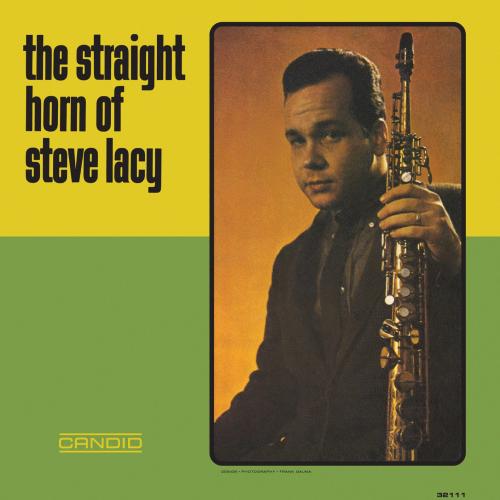
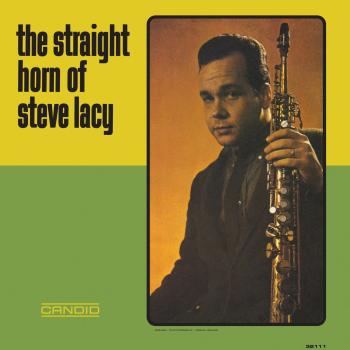
The Straight Horn Of Steve Lacy (Remastered) Steve Lacy
Album info
Album-Release:
2023
HRA-Release:
06.03.2026
Album including Album cover
- 1 Louise (Remastered) 05:24
- 2 Introspection (Remastered) 05:32
- 3 Donna Lee (Remastered) 07:50
- 4 Played Twice (Remastered) 05:53
- 5 Air (Remastered) 06:38
- 6 Criss Cross (Remastered) 05:42
Info for The Straight Horn Of Steve Lacy (Remastered)
The straight horn referred to in the title of this superb album from 1961 is the soprano saxophone, and Lacy is recognized as one of the greatest to ever play the instrument, ranking alongside John Coltrane and Sidney Bechet. Because of the difficulty involved in mastering its pitch challenges, very few jazzmen concentrated on it. Lacy is widely considered the first modern musician to specialize on the instrument.
Lacy had long and prolific career and a fascinating style trajectory. At sixteen he began playing Dixieland with the likes of Pee Wee Russell. In the mid 1950s he played free jazz with Cecil Taylor, and appeared with his groundbreaking quartet at the 1957 New Port Jazz Festival. He made a notable appearance on the 1959 Gil Evens, Great Jazz Standards album. Along the way, Lacy became obsessed with the music of Thelonious Monk, working with him several times including the 1963 Big Band and Quartet in Concert album, and devoted much of this lifes work to the interpretation of Monks materiel.
Only the third session with Lacy as a band leader, The Straight Horn album features three Monk compositions, along side two from Cecil Taylor and Charlie Parkers (or Miles Davis, depending on who you believe) Donna Lee.
The date shows how masterful Lacy was out of the gate, and demonstrates his knack for taking abstract pieces by composers like Monk and Taylor and re-interpreting them in his own unique way. Lacy is able to keep the songs unmistakably identifiable, while transforming them in a way that showcases his own playing.
"Some of soprano saxophonist Steve Lacy's most interesting recordings are his earliest ones. After spending periods of time playing with Dixieland groups and then with Cecil Taylor (which was quite a jump), Lacy made several recordings that displayed his love of Thelonious Monk's music plus his varied experiences. On this particular set, Lacy's soprano contrasts well with Charles Davis' baritone (they are backed by bassist John Ore and drummer Roy Haynes) on three of the most difficult Monk tunes ('Introspection', 'Played Twice', and 'Criss Cross') plus two Cecil Taylor compositions and Charlie Parker's 'Donna Lee'." (Scott Yanow, AMG)
Steve Lacy, soprano saxophone
Charles Davis, baritone saxophone
John Ore, bass
Roy Haynes, drums
Recorded November 19, 1960 at Nola Penthouse Sound Studios, NY
Digitally remastered by Bernie Grundman
Steve Lacy
was the first, after Sydney Bechet, to devote himself solely to the soprano saxophone. Through its flexibility, richness of tone and swing, he gave the instrument a new lease of life and inspired John Coltrane to start playing it.
Steven Norman Lackritz was born in 1934 in New York. As a teenager, he photographed musicians to sell their portraits at concerts. It was on this occasion that he met the man who introduced him to jazz: musician and conductor Cecil Scott.
In the early 1950s, he became a professional musician, playing clarinet and saxophone in clubs, while studying at the Schilliger House of Music in Boston and then at the Manhattan School of Music. His meeting with pianist Cecil Taylor in 1953 truly launched his career. Taylor introduced him to the music of Thelonious Monk, who would be his main source of inspiration and whom he would play throughout his life.
He quickly specialized in the soprano saxophone and became its major figure. While he is Cecil Taylor's main partner, he also plays with Roswell Bud, Gil Evans, and Thelonious Monk, his mentor.
In the 1960s, after having participated in the rise of free jazz with Ornette Coleman, he moved to Europe and became one of its main representatives. A musician considered as a soloist, he plays and records a lot in solo (his own compositions and those of Monk), but also in duo or with his band.
Steve Lacy died in 2004 in Boston. He had returned to the United States three years earlier to teach at the New England Conservatory. A leading figure in free jazz and soprano saxophone, he was a source of inspiration for many saxophonists, including John Coltrane.
This album contains no booklet.