

[].
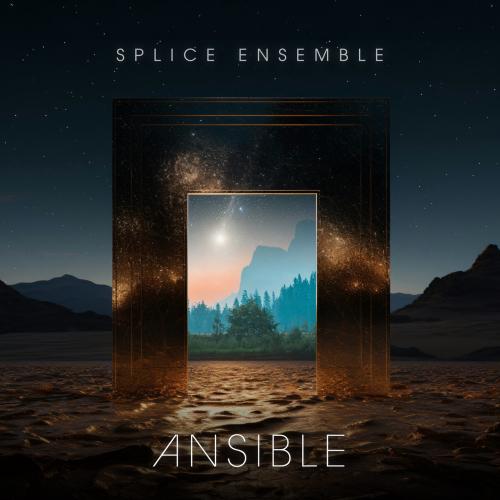
Ansible SPLICE Ensemble
Album info
Album-Release:
2026
HRA-Release:
03.07.2026
Label: New Focus Recordings
Genre: Classical
Subgenre: Chamber Music
Artist: SPLICE Ensemble
Composer: Caroline Louise Miller, Elainie Lillios, Steven Ricks (1969)
Album including Album cover Booklet (PDF)
- Steven Ricks (b. 1969): Motor Culture:
- 1 Ricks: Motor Culture: I. Hank’s Drive Through the Multiverse 05:34
- 2 Ricks: Motor Culture: II. Our Lady of Blessed Acceleration 09:34
- 3 Ricks: Motor Culture: III. Disastrous Experiment 03:49
- Caroline Louise Miller (b. 1988): Ansible:
- 4 Miller: Ansible: I. Antiphony 08:50
- 5 Miller: Ansible: II. Gethen / Icecaps 10:02
- 6 Miller: Ansible: III. Urras / Walls 05:50
- 7 Miller: Ansible: IV. Passacaglia 06:11
- Elainie Lillios (b. 1969): Living Between Seconds:
- 8 Lillios: Living Between Seconds 14:27
Info for Ansible
Electroacoustic composition has been a key component of the pathbreaking edge of the avant-garde for several decades. Works for single acoustic instrument and electronics have perhaps been the most common format in the genre, though integration of electronics into ensemble music has been a hallmark and indeed a highlight since electroacoustic music’s infancy. Less common however have been ensembles whose instrumentation explicitly includes electronics and commissioning efforts that present the electronic component as core to their mission. SPLICE Ensemble (pianist Keith Kirchoff, percussionist Adam Vidiksis, and trumpeter Sam Wells) have staked out a unique position doing just that, as they build a repertoire for their already unusual instrumentation that centers electronics with the fabric of all of their newly commissioned works. On Ansible, they present three fruits of this labor by Caroline Louise Miller, Elainie Lillios, and Steven Ricks.
One salient feature of SPLICE Ensemble is the group’s versatility performing in different stylistic territory, and the ways in which their commissioned repertoire highlights this range. Ricks’ paean to how cars influence modern life leans into SPLICE’s fluency as he explores different associations with the automobile. The opening movement, “Hank’s Drive Through the Multiverse,” begins with energetic, pointed passages of repeated notes and trills on the trumpet, punctuated by improvisatory, freely accumulating cells. We hear fragments of a pre-recorded vocal track peaking through the mix, as Vidiksis’ percussion part fills the texture with taut bursts and looking cymbals and Kirchoff adds punctuated chords and angular gestures. A mute on Wells’ trumpet and shifty movement in the electronics gives a middle section a film noire overtone. Inspired by a line during the the famous car chase scene in The Blues Brothers, “Our Lady of Blessed Acceleration,” Ricks captures the razor’s edge between progress and danger inherent to car travel, jumping around various stylistic frames in collage-like fashion, ending with an expansive passage of electronically harmonized trumpets echoing against a sonic chasm. The final movement, “Disastrous Experiment,” grapples with the sobering ubiquity of auto accidents. Layered recordings of people recounting accident details are interspersed with somber muted trumpet lines, splashes of dissonant harmony in the piano, and dramatic blooms of sound in the percussion.
Caroline Louis Miller’s Ansible is inspired by a device that figured into several novels by the Sci-fi writer Ursula K. Le Guin. In Le Guin’s works, the ansible facilitates instantaneous interstellar communication, becoming invaluable to societies seeking to communicate with each other to avoid conflict. Miller evokes recording of an earlier era in the opening movement, “Antiphony,” a fantasy performed by Kirchoff on a decaying piano whose nostalgic, Romantic gestures are made ever more melancholy by subtle microtonal shading. Vidiksis patiently adds commentary from the drum set before he is unleashed approximately six and half minutes into the track with a burst of virtuosity that portends more extended passages in subsequent movements. “Gethen/Icecaps” features a disembodied trumpet solo against a barren, arctic soundscape of wind sounds, creaking, and bells. Disjunct figures create a sense of disorientation in “Urras/Wells,” a movement that conveys the hurdles and barriers that confront those seeking to put new technologies in the service of altruistic ends. Charged free improvisation exploded from Vidiksis’ drum set amidst a backdrop of a recorded voice intoning, “I knew fear,” and field recordings of general strikes all over the world. The maudlin, decaying piano returns in “Passacaglia,” a loose canon between the three instruments wherein development through variation happens as much through timbral evolution as through manipulation of pitch.
Elainie Lillios recorded environmental sounds in the American southwest as a foundation for her meditation on mindfulness and temporal expansion, Living Between Seconds. The material for SPLICE Ensemble is woven into this sonic ecosystem. Lillios adds a layer of symbiosis to the work, using a live electronics Max patch to interact with the pre-recorded and live sounds, creating “meta-instruments” that expand the range of the fixed media and ensemble alike. Close collaboration and structured improvisation are sources of the work’s collective sensibility, inviting the listener and performers alike to inhabit the musical moment with a heightened sense of awareness.
Through these three distinct pieces and their committed performances, SPLICE Ensemble makes a deeply persuasive case for their mission. Their instrumentation is capable of supporting diverse compositional approaches and stylistic references, while the integration of the electronic element opens up further possibilities for shaping the music’s frame of reference and texture. – Dan Lippel
Keith Kirchoff, piano & electronics
Adam Vidiksis, drum set & electronics
Sam Wells, trumpet & electronics
SPLICE Ensemble
is dedicated to cultivating a canon of electroacoustic chamber music for trumpet, piano, and percussion, bringing together acoustic virtuosity, live electronics, and experimental sound. Called a “sonic foodfight” by Jazz Weekly, SPLICE Ensemble combines instrumental virtuosity and electronic media in performances that expand the possibilities of contemporary chamber music. The ensemble consists of Sam Wells (trumpet), Keith Kirchoff (piano), and Adam Vidiksis (percussion, drum set). All three members are experienced electronic musicians and acoustic performers who collaborate closely with composers to create and perform works that integrate electronics with acoustic instruments. Since its formation in 2016, the ensemble has premiered more than 120 works by over 100 composers, playing a central role in developing the repertoire for instruments and electronics through close collaboration with artists and technologists. The ensemble also maintains a deep commitment to education through its work with students and emerging composers at the SPLICE Institute and Festival. SPLICE Ensemble has worked with composers including Elainie Lillios, Christopher Biggs, Brian Belet, Caroline Louise Miller, Alex Christie, Per Bloland, Flannery Cunningham, Robert Seaback, Joo Won Park, Steve Ricks, and Scott L. Miller, among many others. The ensemble is the resident ensemble of both the SPLICE Institute and SPLICE Festival and has been featured at venues and conferences including M Woods in Beijing, SEAMUS, the Electroacoustic Barn Dance, the SCI National Conference, Electronic Music Midwest, and New Music Detroit’s Strange Beautiful Music festival. Their recordings appear on the SEAMUS, PARMA, and New Focus Recordings labels.
Steven L. Ricks
is described in BBC Music Magazine as a composer “unafraid to tackle big themes.” He creates work that is bold, innovative, ambitious, and diverse, often including strong narrative and theatrical influences. He writes for specific performers and performance situations and works towards unique moments that capitalize on interesting convergences. For the past 15+ years Ricks has also been active as a performer on trombone and laptop (live electronics), most notably with colleague Christian Asplund through the RICKSPLUND free-improvisation duo. Ricks has performed and recorded with RICKSPLUND and other artists, including Douglas Ewart, Vinny Golia, Anne La Berge, Ron Coulter, and Oğuz Büyükberber. He has received commissions and awards from the Fromm Music Foundation, the Barlow Endowment, SCI, and The Center for Latter-day Saint Arts, among others. Recordings of his music appear on multiple labels, including Bridge Records, New Focus Recordings, Neuma Records, Albany Records, pfMENTUM, Vox Novus, TryTone, and Comprovise Records.
Ricks is a professor in the BYU School of Music where he teaches music theory and composition. He is currently a member of the Board of Advisors for the Barlow Endowment (2026-30), and was formerly BYU School of Music Composition and Theory Division Coordinator (2016-24), Editor of the Newsletter for the Society for Electro-Acoustic Music in the United States (2012-19), and director of the BYU Electronic Music Studio for 20 years (2001-21).
Caroline Louise Miller
(they/them) is a US composer based in Portland, Oregon. Common themes in their work include affect, ecology, labor politics, tactility, and the materiality of media, often within dreamlike musical spaces that incorporate field recordings and electronic textures with acoustic instruments. They have enjoyed wide-ranging collaborations and have been supported by numerous grants, fellowships, and commissions; including from Seattle Modern Orchestra, Alarm Will Sound/Matt Marks Impact Fund, New Wave Opera, Chamber Music America Classical Commissioning Program, SPLICE Ensemble, Ensemble Adapter, Portland Jazz Composers Ensemble, Guerilla Opera, Transient Canvas, and others. Their music is performed nationally and internationally. In 2014, Miller worked as an artist-in-residence aboard a Scripps Institution of Oceanography research vessel in the Philippine Sea. Field recordings from the ship were used to compose the score for a feature-length experimental documentary by Lyndsay Bloom about daily life aboard the ship. Miller’s multimedia installation Here There: (Re)collecting Labor on the American Railway, co-created with artist Stefani Byrd and featuring a score recorded with Alarm Will Sound, incorporates field recordings and video footage taken at endangered historic sites in Northern California, and has been exhibited internationally. From 2012-2017, Miller organized and curated an annual cross-disciplinary collaborative arts showcase at the Birch Aquarium in La Jolla. Miller is currently Assistant Professor of Sonic Arts at Portland State University, where they teach courses including electronic music composition, songwriting, studio production, and music for visual media. They hold a Ph.D in Music from UC San Diego.
Elainie Lillios
Acclaimed as one of the “contemporary masters of the medium” by MIT Press’s Computer Music Journal, Elainie Lillios creates works that reflect her fascination with listening, sound, space, time, immersion, and anecdote. Her compositions include stereo, multi-channel, and Ambisonic fixed media works, instrument(s) with live electronics, collaborative experimental audio/visual animations, and installations. She also performs live electronics with ESC Trio collaborators Chris Biggs and Scott Deal, and with Origami Sound Society collaborator Mark Nagy.
Elainie attributes her success to the many professors whose patience and fortitude helped her explore and understand creativity, intent, technique, experimentation, professionalism, composition, and other important life lessons. She continues to be inspired by her many former students whose explorations and successes make her proud to have been a small part of their journey as musicians and humans. Elainie counts herself fortunate to have numerous colleagues and friends in the field who have become her “other” family — her collaborators and performers, SPLICE colleagues, UK and European acousmatic composer clan, and other amazing humans. Thank you ALL for making this journey an AWESOME one!
Elainie retired from Bowling Green State University in May 2025 but continues sharing offbeat and often eccentric ideas about composition and experimentation through part time teaching at Western Michigan University. She serves as SPLICE Institute Director (www.splicemusic.org) and teaches there as well. She also fundraises for and builds homes at Project Mexico (www.projectmexico.org/homebuilding) and explores #vanlife with husband Michael Thompson and dog Dude.
Booklet for Ansible