




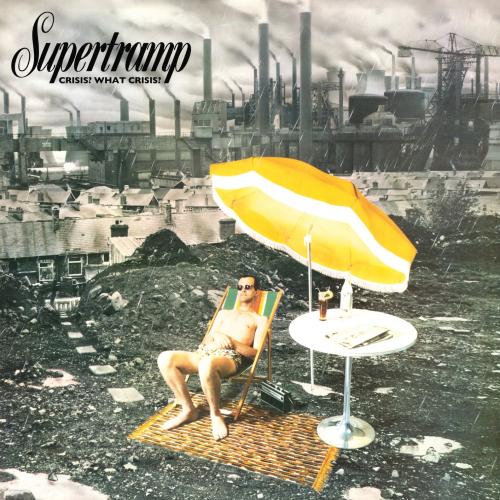
Crisis? What Crisis? (Remastered 2025) Supertramp
Album info
Album-Release:
1975
HRA-Release:
23.01.2026
Album including Album cover
I`m sorry!
Dear HIGHRESAUDIO Visitor,
due to territorial constraints and also different releases dates in each country you currently can`t purchase this album. We are updating our release dates twice a week. So, please feel free to check from time-to-time, if the album is available for your country.
We suggest, that you bookmark the album and use our Short List function.
Thank you for your understanding and patience.
Yours sincerely, HIGHRESAUDIO
- 1 Easy Does It (Remastered 2025) 02:17
- 2 Sister Moonshine (Remastered 2025) 05:15
- 3 Ain't Nobody But Me (Remastered 2025) 05:06
- 4 A Soapbox Opera (Remastered 2025) 04:50
- 5 Another Man's Woman (Remastered 2025) 06:20
- 6 Lady (Remastered 2025) 05:24
- 7 Poor Boy (Remastered 2025) 05:08
- 8 Just A Normal Day (Remastered 2025) 03:59
- 9 The Meaning (Remastered 2025) 05:21
- 10 Two Of Us (Remastered 2025) 03:29
Info for Crisis? What Crisis? (Remastered 2025)
Supertramp’s acclaimed third album Crime Of The Century was a worldwide hit, but its success brought pressure to bear on the band. Indeed, the London quintet had barely completed the subsequent tour before A&M Records were demanding they return to the studio with producer Ken Scott to begin work on their next record Crisis? What Crisis?
“Crisis? What Crisis? came to mean more to us as a title than it did to other people, because it really was a crisis album,” vocalist and multi-instrumentalist Roger Hodgson confessed in an interview with U.K. rock weekly Sounds in 1977. “We learnt how not to make an album coming right off the road and going into the studio. We had a lot of bad luck in the studio. We really didn’t enjoy making it and in the end it was kind of a patch-up job.”
Hindsight, though, suggests Hodgson’s critique was unnecessarily harsh. Yes, Crisis? What Crisis? put Supertramp in the invidious position of creating a new album from scratch (give or take a couple of leftovers from Crime Of The Century), but as they also had two of the most dexterous and nuanced writers in 70s rock in Hodgson and vocalist-keyboardist Rick Davies, they had all the talent they needed.
Accordingly, while its songs may have been born from stress, the listener struggles to detect it, as Supertramp’s versatility and guile are stamped all over Crisis? What Crisis? Two of Hodgson’s best, the deceptively languid, George Harrison-esque “Easy Does It” and the happy-sad, woodwind-assisted “Sister Moonshine,” immediately set the bar high, but Davies ably responds with a pair of robust, blues-rock workouts in “Ain’t Nobody But Me” and the admirably funky “Another Man’s Woman.”
Elsewhere, the band showcases its collective skill in melding mainstream pop and progressive rock tropes on the epic six-minute “A Soapbox Opera” before breaking new ground on the jazz-inflected “Poor Boy” and signing off with one of Hodgson’s loveliest songs, “Two Of Us”: a gentle, stripped-back ode to endurance which makes for the perfect postscript to an adventurous record.
Despite Supertramp collectively feeling that corners were cut during the making of Crisis? What Crisis?, when the album was released in November 1975, fans happily accepted it as the fine follow-up to Crime Of The Century it always was.
Its sales fell a little short of its illustrious predecessor, but it still made the U.K. Top 20 and the Top 50 of the U.S. Billboard 200 — and it capped off a more than decent performance by rewarding Supertramp with a further flurry of gold discs. It’s cemented its reputation by remaining a fan favorite, with Supertramp’s own perception of their troubled creation even mellowing over time.
"Nestled between the accomplished Crime of the Century album and 1977's Even in the Quietest Moments, Crisis? What Crisis? may not have given the band any chart success, but it did help them capture a fan base that had no concern for Supertramp's commercial sound. With Rick Davies showing off his talent on the keyboards, and Roger Hodgson's vocals soaring on almost every track, they managed to win back their earlier progressive audience while gaining new fans at the same time. Crisis received extensive air play on FM stations, especially in Britain, and the album made it into the Top 20 there and fell just outside the Top 40 in the U.S. "Ain't Nobody But Me," "Easy Does It," and the beautiful "Sister Moonshine" highlight Supertramp's buoyant and brisk instrumental and vocal alliance, while John Helliwell's saxophone gives the album even greater width. The songwriting is sharp, attentive, and passionate, and the lyrics showcase Supertramp's ease at invoking emotion into their music, which would be taken to even greater heights in albums to come. Even simple tracks like "Lady" and "Just a Normal Day" blend in nicely with the album's warm personality and charmingly subtle mood. Although the tracks aren't overly contagious or hook laden, there's still a work-in-process type of appeal spread through the cuts, which do grow on you over time." (Mike DeGagne, AMG)
Roger Hodgson, guitars, keyboards, lead vocals (tracks 1, 2, 4, 6, 8-10)
Richard Davies, keyboards, harmonica, lead vocals (tracks 3, 5, 7, 8)
John Anthony Helliwell, wind instruments, backing vocals
Dougie Thomson, bass
Bob Siebenberg, drums, percussion
Richard Anthony Hewson, orchestra & choir arrangements
Digitally remastered by Miles Showell at Abbey Road Studios
Please Note: we do not offer the 192kHz version of this album, because our analysis clearly showed, that the 192kHz does not reach a frequency spectrum, that would justify to offer 192kHz. Hence we offer the 96kHz version.
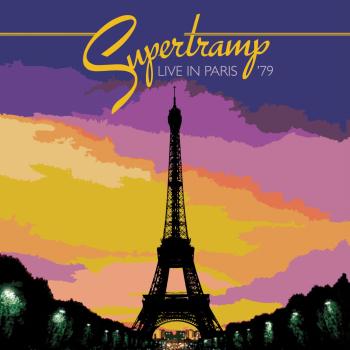
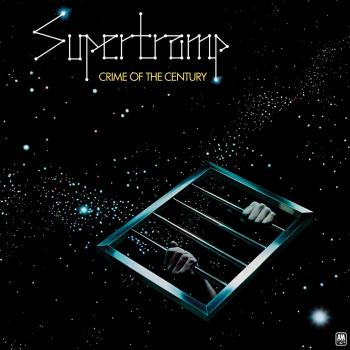
Supertramp
Once upon a time in 1969, a young Dutch millionaire by the name of Stanley August Miesegaes gave his acquaintance, vocalist and keyboardist Rick Davies a genuine opportunity to form his own band; he could form the band of his dreams and Miesegaes would pay for it. After placing an ad in Melody Maker, Davies assembled Supertramp.
Supertramp released two long-winded progressive rock albums before Miesegaes withdrew his support. With no money or fan base to speak of, the band was forced to redesign their sound. Coming up with a more pop-oriented form of progressive rock, the band had a hit with their third album, Crime of the Century. Throughout the decade, Supertramp had a number of best-selling albums, culminating in their 1979 masterpiece, Breakfast in America.
Breakfast in America marked their first album that tipped the scale completely in the favor of pop songs; on the strength of the hit singles Goodbye Stranger, Logical Song, and Take the Long Way Home it sold over 18 million copies worldwide. After that album, Supertramp continued to develop a more R&B-flavored style; the change in direction was successful on 1982's Famous Last Words, but they soon ran out of hits. The band continued to sporadically record and tour into the '90s. (Source: Stephen Thomas Erlewine, All Music Guide)
This album contains no booklet.