

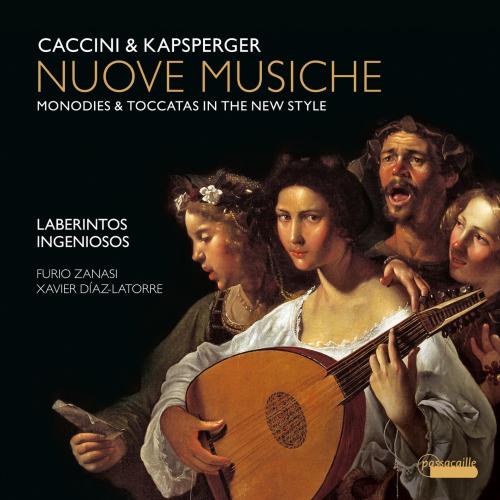
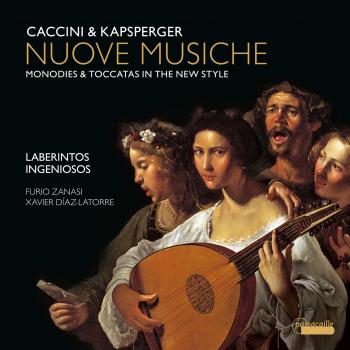
Caccini & Kapsperger, Nuove Musiche: Monodies & Toccatas in the New Style Furio Zanasi & Xavier Díaz-Latorre
Album info
Album-Release:
2026
HRA-Release:
30.01.2026
Label: Passacaille
Genre: Classical
Subgenre: Vocal
Artist: Furio Zanasi & Xavier Díaz-Latorre
Composer: Giulio Caccini (1545-1618), Giovanni Kapsberger (1580-1651)
Album including Album cover Booklet (PDF)
- Giulio Caccini (1551 - 1618): Le nuove musiche:
- 1 Caccini: Le nuove musiche: No. 9, Sfogava con le stelle 02:33
- Giovanni Girolamo Kapsperger (1580 - 1651): Libro quarto d’intavolatura di chitarrone:
- 2 Kapsperger: Libro quarto d’intavolatura di chitarrone: Kapsberger 04:27
- Giulio Caccini: Nuove musiche e nuova maniera di scriverle:
- 3 Caccini: Nuove musiche e nuova maniera di scriverle: No. 14, Vaga su spin'ascosa 02:57
- 4 Caccini: Nuove musiche e nuova maniera di scriverle: No. 31, Tu ch'hai le penne Amore 03:15
- Giulio Caccini: Le nuove musiche:
- 5 Caccini: Le nuove musiche: No. 1, Movetevi à pietà 02:24
- Giovanni Girolamo Kapsperger: Libro quarto d’intavolatura di chitarrone:
- 6 Kapsperger: Libro quarto d’intavolatura di chitarrone: Passacaglia No. 4 05:41
- Giulio Caccini: Nuove Musiche, Arie a una e più voci di diversi autori:
- 7 Caccini: Nuove Musiche, Arie a una e più voci di diversi autori: Almi luci beate 03:26
- Nuove Musiche e nuova maniera di scriverle:
- 8 Caccini: Nuove Musiche e nuova maniera di scriverle: No. 29, Amor, ch’attendi 01:35
- Le nuove musiche:
- 9 Caccini: Le nuove musiche: No. 11, Dovrò dunque morire? 02:14
- Giovanni Girolamo Kapsperger: Libro quarto d’intavolatura di chitarrone:
- 10 Kapsperger: Libro quarto d’intavolatura di chitarrone: Canario 03:17
- Giulio Caccini: Le nuove musiche:
- 11 Caccini: Le nuove musiche: No. 7, Vedrò ’l mio sol 03:10
- Nuove musiche e nuova maniera di scriverle:
- 12 Caccini: Nuove musiche e nuova maniera di scriverle: No. 32, Al fonte, al prato 02:10
- 13 Caccini: Nuove musiche e nuova maniera di scriverle: No. 9, Ch’io non t’ami, cor moi 01:38
- Giovanni Girolamo Kapsperger: Sferraina and improvisation upon the Collascione:
- 14 Kapsperger: Sferraina and improvisation upon the Collascione 05:36
- Giulio Caccini: Nuove musiche e nuova maniera di scriverle:
- 15 Caccini: Nuove musiche e nuova maniera di scriverle: No. 16, Tutti il dì piango 06:11
- 16 Caccini: Nuove musiche e nuova maniera di scriverle: No. 28, Non ha ’l ciel cotanti lumi 02:37
- 17 Caccini: Nuove musiche e nuova maniera di scriverle: No. 20, Torna, deh torna, pargoletto mio 03:36
- Giovanni Girolamo Kapsperger: Libro quarto d’intavolatura di chitarrone:
- 18 Kapsperger: Libro quarto d’intavolatura di chitarrone: Capona 02:43
- Giulio Caccini: Nuove musiche e nuova maniera di scriverle:
- 19 Caccini: Nuove musiche e nuova maniera di scriverle: No. 35, Dalla porta d'oriente 02:25
- Giovanni Girolamo Kapsperger: Libro primo d'Intavolatura di Chitarone:
- 20 Kapsperger: Libro primo d'Intavolatura di Chitarone: Toccata Arpeggiata 05:23
Info for Caccini & Kapsperger, Nuove Musiche: Monodies & Toccatas in the New Style
In Le Nuove Musiche, Furio Zanasi's richly expressive voice and Xavier Diaz-Latorre's masterful theorbo playing bring new depth to the groundbreaking music of Giulio Caccini and Heinrich Kapsberger. Caccini's radical aesthetic--placing the intelligibility of the text at the center, allowing melody to carry expressive meaning, and reducing the accompaniment to a discreet yet powerful basso continuo--emerges here with remarkable clarity. Zanasi and Diaz-Latorre reveal how innovative Caccini's nobile sprezzatura di canto truly was: a free, speech-like, rhetorically shaped way of singing in which the emotional power of the text directly guides the musical gesture. In their hands, poetry and melody intertwine as a single expressive line, exactly as Caccini and the Florentine Camerata envisioned. Each track draws the listener into a vivid sonic world where the timeless beauty and bold innovation of the early Baroque come alive, offering a fresh and deeply felt perspective on a pivotal moment in music history--an compelling listening experience for all lovers of early music.
Laberintos Ingeniosos:
Furio Zanasi, Gesang
Xavier Díaz-Latorre, Chitarrone & Gitarre
Furio Zanasi
made his career dedicating himself to Early Music, with a repertoire spanning from the madrigal to cantatas, from oratorio to Baroque opera.
He has collaborated with many ensembles and participated in the most prestigious festivals in Italy (Settembre Musica in Torino; Festival Roma Europa, S. Maurizio in Milan, Festival Monteverdi Cremona, Accademia di S. Cecilia in Rome, Accademia Chigiana in Siena, Accademia Filarmonica in Rome), as well as abroad (Utrecht, Beaune, Bruges, Stuttgart, Versailles, Arsenal of Metz, Prague, Wiener Konzerthaus, Folle Journée Nantes, Innsbruck, Salzburg Festivals, Sevilla, Quinzena of San Sebastian, Fundatiao Gulbenkian, Lufthansa Festival in London, Opéra Garnier Paris, Amsterdam Concertgebouw, Carnegie Hall, Ambronay, Berkeley, Khioi Hall Tokyo).
Furio Zanasi has sung under the baton of René Jacobs, Jordi Savall, Alan Curtis, Gabriel Garrido, Maurizio Pollini, Ivor Bolton, Reinhard Goebel, Rinaldo Alessandrini, Alessandro De Marchi, Ottavio Dantone, Andrea Marcon, Philippe Herrewege, Thomas Hengelbrock, Riccardo Chailly.
After having debuted in the role of Marcello in La Bohème at the Battistini competition, he appeared in theatres such as: Opera of Rome, Bellini of Catania, Ponchielli in Cremona, Comunale of Ferrara, Alighieri in Ravenna, Massimo of Palermo, Dresdner Semper Oper, Liceu in Barcelona, Zarzuela in Madrid, Theater Basel, La Fenice in Venice, Teatro Regio Torino, Teatro San Carlo of Naples, Staatsoper Muenchen, Festspielhaus Baden-Baden, Opera of Lyon, Opera of Bordeaux, La Monnaie in Bruxelles, Lincoln Center, Teatro Colon.
Furio Zanasi has also recorded for the main European Radios and recorded more than 60 CDs for different labels such as Arts, Bongiovanni, Accord, Naxos, Chandos, K617, Opus 111, Virgin, Aliavox, Zig Zag, Naïve and Harmonia Mundi.
Recent Seasons have seen Furio Zanasi in the title role of Monteverdi’s L’Orfeo in tournée with Rinaldo Alessandrini/Concerto Italiano at Valladolid, Las Palmas, Bilbao, Valencia, Siena, Beaune, with recording for Naive, with Jordi Savall in Bremen, Milan and Spain as well as with Academia Montis Regalis led by Alessandro De Marchi in Turin and again in Oslo, Den Norske Opera in a new production under Rinaldo Alessandrini.
He has sung Haydn’s L’Isola disabitata at Innsbrucker Festwochen with Alessandro De Marchi, in Milan Teatro alla Scala L’Orfeo with Rinaldo Alessandrini, with whom he also recorded for Naïve Vivaldi’s Armida/Califfo Re d’Egitto with concerts in Paris Salle Pleyel and Theater an der Wien.
Among his latest engagements: Ulisse in Il ritorno d’Ulisse in Patria at the Vlaamse Opera in Antwerpen with Federico Maria Sardelli, at Teatro alla Scala in Milan with Rinaldo Alessandrini and Robert Wilson and he will sing again the role at Den Norske Opera in Oslo with Alessandro De Marchi.
Xavier Díaz-Latorre
was born in Barcelona in 1968. He studied at advanced level with Oscar Ghiglia at the Musikhochschule, Basel, graduating in 1993. His subsequent interest in early music led him to study the lute with Hopkinson Smith at the Schola Cantorum Basiliensis. He has completed several courses in choral conducting and a post-graduate course in orchestral conducting.
Since 1995 he has been actively involved in the world of baroque opera, having participated in major productions such as Semele (Handel) at the Berlin State Opera with the Akademie für alte Musik, Berlin, conducted by René Jacobs; L’Orfeo (Monteverdi) at the Goldoni Theatre, Florence, the Théâtre de la Monnaie, Brussels, Covent Garden, London, the Grand Théâtre de Provence, Aix-en-Provence, the Théâtre des Champs Élysées, Paris, and the BAM, New York, again under René Jacobs but with Concerto Vocale; L’Orfeo again, but with Le Concert des Nations and Jordi Savall at the Teatro Real, Madrid and the Liceu, Barcelona; Solimano (Johann Adolf Hasse) at the Berlin and Dresden State Operas with Concerto Köln and René Jacobs; La Serva Padrona (Pergolesi) at the Philharmonie, Berlin and Ludwigsburg Castle with the Balthasar-Neumann Ensemble and Thomas Hengelbrock; Dal Male il Bene (Marco Marazzoli and Antonio Maria Abbatini) at the Landestheater, Innsbruck with Concerto Vocale and Attilio Cremonesi; Don Chisciote della Mancia in Sierra Morena (Francesco Bartolomeo Conti) with the University of Salamanca Baroque Orchestra and Wieland Kuijken.
Xavier Díaz-Latorre frequently takes part in major international festivals in Europe, the USA, South America, and South Korea. He is a member of renowned orchestras and chamber groups such as those conducted by Jordi Savall – Hesperion XXI, La Capella Reial de Catalunya and Le Concert de Nations, and has been invited to perform with other major orchestras and ensembles such as the Orquesta Nacional de España or Al Ayre Español.
He has his own vocal and instrumental ensemble, Laberintos Ingeniosos, which specialises in performance of music from the Spanish Golden Age. The group’s first disc, Danzas de Rasgueado y Sones de Palacio, with music by the Aragonese composer Gaspar Sanz, recorded on the Zig-Zag Territoires label, has received excellent reviews in the media, and has been broadcast by several international radio stations throughout Europe, Israel, Australia, South Korea and North America. Laberintos Ingeniosos has now made further CDs of music from the Iberian Peninsula performed on period instruments, such as Goyesca, seguidillas boleras, with music by Fernando Sor, and “...entre el cielo y el infierno...”, with works by Francisco de Guerau and José Marín. In addition, Xavier Díaz-Latorre has taken part in over 30 CDs for Alia Vox and Deutsche Harmonia Mundi, and has made recordings for numerous television and radio stations in Europe, North and South America and South Korea.
He has been invited to give courses at many venues in Spain, Italy, Germany and Switzerland, also at Seoul (South Korea). He has been resident teacher of lute, bass continuo and chamber music at the Escola Superior de Música de Catalunya and at the Koninklijk Conservatorium Brussels.
Booklet for Caccini & Kapsperger, Nuove Musiche: Monodies & Toccatas in the New Style