


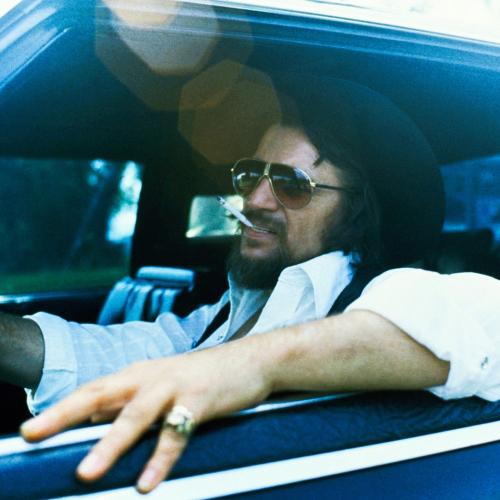
Diamonds Waylon Jennings
Album info
Album-Release:
2026
HRA-Release:
13.11.2026
Album including Album cover
- 1 Diamonds 03:59
- 2 Saturday Night Special 02:22
- 3 I Never Said It Would Be Easy 03:05
- 4 I'm Tired (feat. Jessi Colter) 02:49
- 5 Wild & Blue 02:56
- 6 The Good Things Don't Last Very Long 03:05
- 7 She Smiles Like A River 02:57
- 8 I Just Ain't Been Able 02:27
- 9 Lost Love Song 03:35
- 10 Same Old Blues (feat. Jessi Colter) 02:38
- 11 Born Too Late 03:23
- 12 Words 05:25
Info for Diamonds
Today, 4x GRAMMY® Award-winner Shooter Jennings announces the release of "Diamonds", a new album of previously unheard songs by his legendary father, Waylon Jennings. The title track was featured on a special CBS Sunday Morning story on Shooter and Waylon Jennings.
Diamonds is the second in a series of albums featuring previously unknown recordings by Waylon Jennings that his son, Shooter Jennings, recently unearthed. Diamonds is heralded by the title track out today. The song features a surprise appearance by the late great Glen Campbell, who joins Gordon Payne, Jerry Bridges, Carter Robertson, Barney Robertson, Rance Wasson, the collective known as the Waylors, in backing Waylon Jennings.
“This track eluded me,” says Shooter Jennings. “I kept finding it across three different sessions while I was going through my father‘s work. At first, I was very confused because of the sound of the guitar as to what it was. Suddenly, upon listening to the whole thing, I realized Glen Campbell had stopped by the studio and they recorded this little gem on a late December night in 1978. The remaining members of the Waylors helped put the picture together. It quickly became one of my favorite recordings that my dad ever made and I knew I had to have a whole album centered around it.”
Shooter shared the first installment of newly uncovered songs last year with Songbird, which was met by widespread acclaim from such publications as NY Times, the Tennessean, Rolling Stone, Consequence of Sound, Billboard, Stereogum, Variety, American Songwriter, Parade, Whiskey Riff, Holler Country and many more.
“Back in 2024 when I opened my dad’s personal recording archives, I found a treasure trove of unheard recordings. It was a life-altering event and immediately ignited a feeling of urgency to get these recordings out there to our family of fans who had so loyally kept him alive by listening to and singing his music.
"Last year I released Songbird and I was so touched and delighted at how well-received this music was for my dad. With his voice exalted, I was very excited to deliver on my promise for more music. So, here it goes! I give to you guys: Diamonds.
In the process of combing through and cataloging all of his recordings, I started to get a grasp on all of the music that had not been heard before, and a story started to emerge in my mind. The way I wanted to reveal all of this music to the world was part of my job. With Songbird I knew it would be an emotional journey, hearing Waylon, in his prime, sing new songs to us was going to hit hard. A set of songs almost immediately presented itself to me as Songbird. But there was a second set forming, anchored by the mysterious song “Diamonds.” It was a higher energy album, a “younger man’s” album, if you will.
I immediately knew which songs were attaching themselves to the second album, and they all shared stories about the rollercoaster of relationships and unrequited love. Among the many Jessi Colter songs I found in the batch, two stood out as part of what Diamonds was becoming, so I selected them to add to the album to weave the tale a little more colorfully. Again, the Waylors and legendary harp player Mickey Raphael helped me close the book on a few of these songs. We had a blast. Now, I’m done and Diamonds is in your hands. Pour yourself a cup of something, turn down the lights and let’s take a ride together.” — Shooter Jennings
Waylon Jennings


Waylon Jennings
The American singer-songwriter Waylon Jennings (1937–2002) was an iconic figure in the so-called outlaw movement in 1970s country music. Jennings's influence loomed large among the artists who fused country, rock, and blues influences.
In the words of Andrew Dansby of Rolling Stone, “It's simply impossible to imagine Southern rock, from Allman to Van Zant, and fringe country from Steve Earle to Uncle Tupelo without Waylon Jennings.” The artistic independence that allowed Jennings to accomplish his innovations was hard-won, however. Possessing a melodious baritone voice and a relaxed, pleasantly raffish image, he spent the first part of his career within Nashville's established studio system, achieving significant chart success under the direction of the RCA label's legendary producer Chet Atkins. When Jennings became dissatisfied with music he found to lack the edge of real life, he challenged the structure of Nashville's music-making machinery. By insisting on using his own band in the studio and recording original songs as well as those penned by other renegade songwriters, Jennings achieved lasting commercial success. His 1976 album Wanted: The Outlaws, recorded with kindred spirit Willie Nelson, Jennings's wife Jessi Colter, and songwriter Tompall Glaser, became the first millionselling LP recorded in Nashville. Jennings became one of the superstars of country music during the last quarter of the 20th century, and his fan base extended well beyond the country-music world.
Claiming both Cherokee and Comanche ancestry, Wayland Arnold Jennings was born in tiny Littlefield, Texas, amid cotton fields northwest of Lubbock, on June 15, 1937. After a friend asked whether he was named after nearby Wayland Baptist University, his mother changed the spelling of his name to Waylon. Both of Jennings's parents were musicians who played local gigs, and his mother taught him to play the guitar. He worked as a cotton-picker during his early teens, and like other young men in his position, Jennings viewed music as a way out of a life of agricultural labor. Meanwhile, the job brought him into contact with local African Americans and their music. “I worked in the fields with black people and never paid much attention to it,” he recalled to Dansby. “They had the flats back then and I was probably the only white boy they'd let go down there when they had somebody in town playing music, because I delivered ice.”
Jennings dropped out of high school and got a job as a disc jockey at Lubbock radio station KVOW, hosting a twohour country-music show. From the beginning, he was enthusiastic about the music of Ernest Tubb, Bob Wills, and other classic figures of the genre, as well of the work of country-blues fusion pioneer, Jimmie Rodgers. Jennings formed a band, the Texas Longhorns, and met Elvis Presley during Presley's second visit to Lubbock. “I loved that churning rhythm on the bottom,” he recalled of Presley's sound. By 1958, Jennings had moved down the street to station KDAV, and while there he met Lubbock native Buddy Holly, who had just fired his band, the Crickets. Holly produced Jennings's debut single, a version of the Cajun standard “Jole Blon.” Jennings signed as Holly's bassist for a winter tour in 1958–59. When Holly's plane crashed in snowy weather on February 3, 1959, Jennings had been scheduled to be on board. According to Jennings's autobiography, Holly had joshed with Jennings, saying “I hope your damned bus freezes up again,” to which Jennings replied, “I hope your ol' plane crashes.”
With Atkins as producer, Jennings released his first majorlabel album, Folk-Country, in 1965, and he kept up a busy schedule at RCA, issuing several albums a year through the early 1970s. He was successful from the beginning and reached the top-five spot on the country music charts with the singles “Walk on out of My Mind” (1967), “Only Daddy That'll Walk the Line” (1967), “Brown Eyed Handsome Man” (1969; a cover of Chuck Berry's rock-and-roll hit), “The Taker” (1970), and “Good Hearted Woman” (1971).
By 1972, however, Jennings's upward chart trajectory had stalled, and he felt creatively restless. He wanted to record with his own band, something unheard of in the studio-dominated Nashville system of the time (and still not common). However, he had made connections with songwriters on the fringe of that system, such as fellow Texan Billy Joe Shaver. Shaver had barged in on a Jennings studio session and threatened violence if the singer did not listen to his songs. Jennings agreed to listen and the result was the 1973 album Honky Tonk Heroes. All but one song on the LP was a Shaver composition, and the lyrics dealt with such previously taboo subjects as an interracial sexual encounter and a drug arrest in Mexico. While Honky Tonk Heroes was only moderately successful, it inaugurated Jennings's outlaw period and went on to become a classic.
Although Nashville's promotional firms reacted coolly to the singer's new direction, Jennings countered by hiring New York City–based manager Neil Reshen, who booked Jennings into clubs—like Max's Kansas City in New York City—that had previously been off limits to country performers. Jennings's creative instincts were soon validated commercially. Both his 1974 single releases, “This Time” and “I'm a Ramblin' Man,” reached the top of the country charts, giving him the first two of his eventual 16 numberone singles.
Four successive Jennings albums—Dreaming My Dreams (1975), Are You Ready for the Country (1976), Ol' Waylon (1977), and I've Always Been Crazy (1978)—reached the number-one spot. Although 1979's What Goes around Comes Around stalled at number two, Jennings returned to the top with Music Man (1980). He wrote many of these hits, including the title track of I've Always Been Crazy, with its confession that “I've always been crazy—it's kept me from going insane.” Jennings also recorded several chart-topping singles with Nelson, including the ubiquitous “Mammas Don't Let Your Babies Grow up to Be Cowboys.”
Not only in their hard-living themes but also in their sound, Jennings's songs were innovative, standing out from the country music airing on the radio at the time. His music was influenced by rock and roll, with strong electric bass lines that gave it a four-four beat rather than country music's traditional two-step rhythm. Jennings did not discard country music's traditions, however; he obviously revered them, and he paid tribute to Wills in his lyrics for “Bob Wills Is Still the King.” In his hit single “Are You Sure Hank Done It This Way?,” he questioned whether the Nashville mainstream was really carrying forward the traditions laid down by country legend Hank Williams. ...
This album contains no booklet.