

Album info
Album-Release:
2026
HRA-Release:
09.10.2026
Label: Alpha Classics
Genre: Classical
Subgenre: Vocal
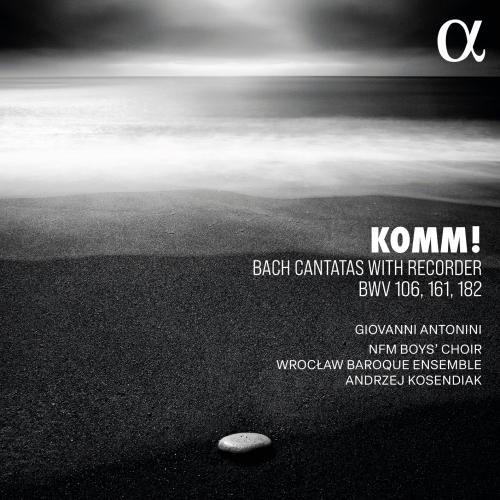
Artist: Giovanni Antonini, NFM Boys’ Choir, Wrocław Baroque Ensemble & Andrzej Kosendiak
Composer: Johann Sebastian Bach (1685-1750)
Album including Album cover Booklet (PDF)
- Johann Sebastian Bach (1685 - 1750): Gottes Zeit ist die allerbeste Zeit, BWV 106 "Actus tragicus":
- 1 Bach: Gottes Zeit ist die allerbeste Zeit, BWV 106 "Actus tragicus": I. Sonatina 02:38
- 2 Bach: Gottes Zeit ist die allerbeste Zeit, BWV 106 "Actus tragicus": IIa. Chor. Gottes Zeit ist die allerbeste Zeit 01:39
- 3 Bach: Gottes Zeit ist die allerbeste Zeit, BWV 106 "Actus tragicus": IIb. Arioso (Tenor). Ach, Herr, lehre uns bedenken 02:06
- 4 Bach: Gottes Zeit ist die allerbeste Zeit, BWV 106 "Actus tragicus": IIc. Aria (Bass). Bestelle dein Haus 01:02
- 5 Bach: Gottes Zeit ist die allerbeste Zeit, BWV 106 "Actus tragicus": IId. Chor und Aria (Soprano). Es ist der alte Bund 03:24
- 6 Bach: Gottes Zeit ist die allerbeste Zeit, BWV 106 "Actus tragicus": IIIa. Aria (Alto). In deine Hände befehl ich meinen Geist 02:08
- 7 Bach: Gottes Zeit ist die allerbeste Zeit, BWV 106 "Actus tragicus": IIIb. Arioso (Bass) und Choral (Alto). Heute wirst du mit mir im Paradies sein 04:01
- 8 Bach: Gottes Zeit ist die allerbeste Zeit, BWV 106 "Actus tragicus": IV. Chor. Glorie, Lob, Ehr und Herrlichkeit 02:51
- Komm, du süsse Todesstunde, BWV 161:
- 9 Bach: Komm, du süsse Todesstunde, BWV 161: I. Aria (Alto) und Choral. Komm, du süße Todesstunde 04:25
- 10 Bach: Komm, du süsse Todesstunde, BWV 161: II. Recitative (Tenor). Welt! deine Lust ist Last 01:59
- 11 Bach: Komm, du süsse Todesstunde, BWV 161: III. Aria (Tenor). Mein Verlangen 04:50
- 12 Bach: Komm, du süsse Todesstunde, BWV 161: IV. Recitativ (Alto). Der Schluss ist schon gemacht 01:57
- 13 Bach: Komm, du süsse Todesstunde, BWV 161: V. Chor. Wenn es meines Gottes Wille 02:30
- 14 Bach: Komm, du süsse Todesstunde, BWV 161: VI. Choral. Der Leib zwar in der Erden 01:15
- Himmelskönig, sei willkommen, BWV 182:
- 15 Bach: Himmelskönig, sei willkommen, BWV 182: I. Sonata 01:55
- 16 Bach: Himmelskönig, sei willkommen, BWV 182: II. Chor. Himmelskönig, sei willkommen 03:04
- 17 Bach: Himmelskönig, sei willkommen, BWV 182: III. Recitativ (Bass). Siehe, ich komme, im Buch ist von mir geschrieben 00:36
- 18 Bach: Himmelskönig, sei willkommen, BWV 182: IV. Aria (Bass). Starkes Lieben 02:21
- 19 Bach: Himmelskönig, sei willkommen, BWV 182: V. Aria (Alto). Leget euch dem Heiland unter 06:46
- 20 Bach: Himmelskönig, sei willkommen, BWV 182: VI. Aria (Tenor). Jesu, lass durch Wohl und Weh 03:18
- 21 Bach: Himmelskönig, sei willkommen, BWV 182: VII. Jesu, deine Passion 03:27
- 22 Bach: Himmelskönig, sei willkommen, BWV 182: VIII. Chor. So lasset uns gehen in Salem der Freuden 03:40
- Komm, süsser Tod, komm, selge Ruh!, BWV 478:
- 23 Bach: Komm, süsser Tod, komm, selge Ruh!, BWV 478 06:05
Info for Komm!
As the founder of the Wrocław Baroque Ensemble, which performs on period instruments, the Polish conductor Andrzej Kosendiak is a champion of Baroque music and has specialised in oratorios and cantatas from various periods. Giovanni Antonini has a special connection with this city and this ensemble, as he has been artistic director of Wratislavia Cantans from 2013 to 2024. The flautist and founding conductor of Il Giardino Armonico was invited by Kosendiak to perform as soloist in Bach’s cantatas featuring the flute: BWV 106, known as Actus Tragicus, BWV 161 Komm, du süße Todesstunde, BWV 182 – Bach’s only cantata for Palm Sunday – and finally the hymn for solo voice with basso continuo, BWV 478 Komm, süßer Tod, komm selge Ruh!. ‘In Bach’s cantatas, the flute is never merely ornamental: depending on the moment, it is the “voice of the spirit”, the breath of prayer…’, writes Piotr Maculewicz. The NFM Boys’ Choir joins the soloists and musicians in this invitation to “enter” Bach’s spiritual world!
Stanislaw Adamus, soprano
Daniel Elgersma, countertenor
Piotr Olech, countertenor
Adam Krzeszowiec, tenor
Maciej Gocman, tenor
Florian Cramer, tenor
Tomas Kral, bass
Jaromir Nosek, bass
NFM Boys' Choir
Giovanni Antonini, recorder
Sheng-Fang Chiu, recorder
Wroclaw Baroque Orchestra
Andrzej Kosendiak, conductor

Giovanni Antonini
Born in Milan, Giovanni studied at the Civica Scuola di Musica and at the Centre de Musique Ancienne in Geneva. He is a founder member of the ensemble Il Giardino Armonico, which he has led since 1989 and with whom he has given concerts worldwide.
He works with artists such as Cecilia Bartoli, Giuliano Carmignola, Isabelle Faust, Sol Gabetta, Patricia Kopatchinskaja, Katia e Marielle Labèque,Viktoria Mullova and Giovanni Sollima. Giovanni is Principal Guest Conductor of Kammerorchester Basel and Mozarteum Orchester Salzburg and regularly guest conducts orchestras such as the Berliner Philharmoniker, Concertgebouworkest Amsterdam, London Symphony, Chicago Symphony, Tonhalle Orchester Zurich.
He has conducted numerous opera productions at La Scala, Theater an der Wien, Salzburg Festival and Opernhaus Zurich. He has recorded for Teldec, Decca, Sony BMG, Naïve, Harmonia Mundi and Alpha. Giovanni is Artistic Director of the Wratislavia Cantans Festival (www.wratislaviacantans.pl) and the Haydn 2032 project, created to perform and record the entire symphonies of Franz Joseph Haydn by the 300th anniversary of his birth.
Wroclaw Baroque Orchestra
ounded in 2006 by Andrzej Kosendiak, it is a resident ensemble of the Witold Lutosławski National Forum of Music, one of few cultural institutions in Poland boasting its own Baroque orchestra playing historical instruments. During each NFM concert season, WBO presents its own concert series, always ardently applauded by the audience. The WBO repertoire encompasses works from early Baroque to Romanticism, from chamber line-ups to large oratorios. The superb cellist Jarosław Thiel has been Artistic Director of WBO since its inception.
Today, Wrocław Baroque Orchestra counts among the most important Polish ensembles playing historical instruments. The orchestra’s output and high level of performance result in collaborations with the biggest names on the international early music scene. WBO has performed under the baton of Philippe Herreweghe, Giovanni Antonini, Andrew Parrott, Paul McCreesh, Andreas Spering, Hans-Christoph Rademann, Laurence Cummings, Justin Doyle, Howard Arman, Rubén Dubrovsky, and Christian Curnyn. The orchestra has invited excellent ensembles and soloists, and among them Collegium Vocale Gent, Rias Kammerchor, Cantus Cölln, Vocalconsort Berlin, Taverner Consort, Dresdner Kammerchor, Gli Angeli Genève, Julia Lezhneva, Vivica Genaux, Regula Mühlemann, Renata Pokupić, Tim Mead, Daniel Taylor and Aleksandra Kurzak. WBO guest performs at prestigious festivals, participates in radio broadcasts and recording sessions.
The first CD of WBO won a Fryderyk in the Phonographic Debut of the Year category, and the following recordings have been nominated for the same award several times. 2017 saw the release of a new album – Haydn The Seasons – a result of collaboration with Paul McCreesh and his Gabrieli Consort & Players (the disc was nominated for Gramophone Awards in the Best Choral Recording category and was a recording of the month of the BBC Music Magazine in June 2017). 2018 saw the release of the album with the premiere recording of the original version of Phantoms by Moniuszko (CD Accord), featuring WBO, and the album 17th-Century Sacred Music in Wrocław, recorded with Gli Angeli Genève and Concerto Palatino under the direction of Stephan MacLeod (Claves). The former received a Fryderyk 2019 in the Album of the Year – Choral Music, Oratorio and Opera category, the latter an International Classical Music Award 2019 in the Baroque Vocal category.
In 2019, an album recorded under the baton of Andrzej Kosendiak with works by Marcin Józef Żebrowski (CD Accord) was released and later nominated for a Fryderyk 2020 in the Album of the Year – Oratorio and Opera Music category. 2020 saw the release of an album with Karol Kurpiński's Elegy in C minor (world premiere recording), Ignacy Feliks Dobrzyński's Symphony No. 2 (first recording on historical instruments) and The Fairy Tale by Stanisław Moniuszko, recorded under the direction of Jarosław Thiel (CD Accord). The album was nominated for the International Classical Music Awards. In 2022, the latest album of Wrocław Baroque Orchestra recorded with the Ensemble Polyharmonique under the baton of Jarosław Thiel came out, Johann David Heinichen – Dresden Vespers (world premiere recording; Accent).
Andrzej Kosendiak
is a conductor and teacher, one of the most active musicians and organisers of musical life in Poland. He is a graduate of the Department of Composition, Conducting and Music Theory at the Academy of Music in Wrocław. In the years 2001–2009, he was head of the Inter-Faculty Study of Early Music there, in 2013 he obtained a postdoctoral degree; in the years 2014–2016, he lectured at the Academy of Music in Gdańsk. In 2021, he received the title of professor. Since 2018, to the present day he has been teaching at his alma mater.
In 2005, he became director of the Wrocław Philharmonic and International Festival Wratislavia Cantans – he led to the change of both institutions and their transformation into the Witold Lutosławski National Forum of Music, which he led until September 2024. After that time, he took over the role of artistic advisor to the NFM director and artistic director of the Andrzej Markowski International Festival Wratislavia Cantans.
The opening of the new venue of the National Forum of Music, which was created thanks to his initiative and efforts, was awarded the Coryphaeus of Polish Music 2016 in the Event of the Year category. Andrzej Kosendiak also contributed to the establishment of the Society of Polish Philharmonics, in which he served as chair of the Board for three terms. In the years 2016-2019, he was vice-chairman of the Council for Artistic Institutions at the Ministry of Culture and National Heritage, he is a member of the Programme Council for Music of the National Institute of Music and Dance, and since 2021 of the Council of the University of Economics in Wrocław, and the jury of the architectural competition for a new concert hall in Belgrade.
He has established new ensembles, including the NFM Choir, Wrocław Baroque Orchestra, NFM Boys' Choir and NFM Girls' Choir, and also initiated the Leo Festival. In addition, he was one of the co-founders of Music in the City monthly published in the years 2012-2018 by the National Forum of Music. As a conductor, he is particularly interested in early music. In 1985, he founded the Collegio di Musica Sacra ensemble, and in 2013 Wrocław Baroque Ensemble, of which he is artistic director. He has recorded previously unknown works from the University Library in Wrocław and the library in Strasbourg (Wrocław Music Award – Musical Event of the Year 2000 for the album Musica da Chiesa), compositions by Grzegorz Gerwazy Gorczycki (Wrocław Music Prize 2013), Bartłomiej Pękiel and Marcin Mielczewski; most of these recordings were nominated for Fryderyk Awards, and in 2023 a Fryderyk was won by him for album Marcin Józef Żebrowski – Vesperae in Visitatione Beatae Mariae Virginis (Album of the Year – Early Music).
Andrzej Kosendiak regularly conducts philharmonic orchestras in Poland and abroad. He has performed in many European countries, the United States (including collaboration with the University of North Carolina in Chapel Hill) and China. He is extremely active in the field of education. In 1990–2000, he was a visitor for the Centre for Artistic Education, and in 2000–2001 he was director of the Department of Programming and Supervision of Artistic Education at the Ministry of Culture and National Heritage. He initiated educational projects such as Singing Wrocław, Singing Poland, international choir meetings Singing Europe, Mummy, Dady, Song to Me. Thanks to his support, the following were established: the Polish National Youth Choir, Choral Academy, Academy of Early Music (an annual festival combining master classes with concerts), Orchestra Academy (preparing musicians to work in professional ensembles), and the NFM Education Centre. He was the originator of the Musica polonica rediviva programme, which aims to have young artists perform Polish music all over the world with the support of conservatories and festivals (so far, the programme has been implemented in cooperation with the Koninklijk Conservatorium in The Hague, Conservatorio di Musica Luca Marenzio in Brescia and Conservatorio Superior de Música de Aragón in Zaragoza). Andrzej Kosendiak also initiated the album series 1000 Years of Music in Wrocław and Witold Lutosławski. Opera omnia. Thanks to his efforts, a phonographic project has been carried out, including recordings of great oratorio works. The albums released so far have won the BBC Music Magazine Award twice, Diapason d’Or and the Editor’s Choice of Gramophone magazine. In 2018, an album with Stanisław Moniuszko’s Phantoms was released, conducted by Andrzej Kosendiak – recorded by outstanding singers and actors, the NFM Choir and Wrocław Baroque Orchestra; it received a Fryderyk 2019 (Album of the Year – Choral, Oratorio and Opera Music). The albums A.M. Bononcini: La decollazione di San Giovanni Battista featuring Wrocław Baroque Orchestra and Mikołaj Zieleński: Offertoria et communiones totius anni, Kaspar Förster – Sacrae cantiones featuring Wrocław Baroque Ensemble – recorded under the baton of the NFM director – were nominated in the Baroque Vocal category for the International Classical Music Awards, respectively in 2020, 2021 and 2023. The Mielczewski II CD was awarded a Fryderyk 2019 (Album of the Year – Early Music), and a disc with Zieleński's compositions in 2021 (Album of the Year – Early Music). In 2022, thanks to Andrzej Kosendiak, the first vinyl album of the National Forum of Music was released, recorded under his baton by Wrocław Baroque Ensemble with Grzegorz Gerwazy Gorczycki’s Completorium, i.e. a musical setting of selected parts of Compline – the last service of the Liturgy of the Hours.
Andrzej Kosendiak has received numerous awards and distinctions, including: Tulips of the National Day of Life in the Social Initiative category (2011) for the project Mummy, Daddy, Song to Me, the Mayor of Wrocław Award (2016), the Lower Silesian Key to Success in the Greatest Personality in the Promotion of the Region category (2016), Radio Wrocław Kultura – Emocje awards in the categories of Personality of the Cultural Season (2017) and Classical Music (2018), the Austrian Cross of Honour, First Class for Merit in Science and Arts (2018), the Diamond of Wrocław (2018), the Golden Badge of Honour for Merit to the Lower Silesian Voivodeship (2018), the award of the College of Rectors of the Universities of Wrocław and Opole for his activities for the integration of the academic community (2019), the Golden Badge of Honour of Wrocław “Wrocław with Gratitude – Wratislavia grato animo” (2020), and for his outstanding achievements in popularising culture, his service to artistic education and the development of music he was awarded the Officer’s Cross of the Order of Polonia Restituta (2023).
Booklet for Komm!