







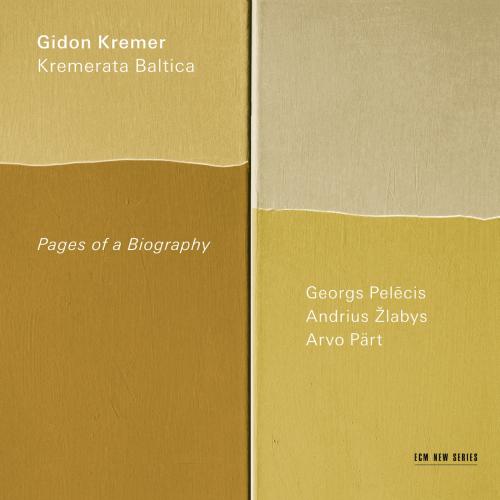
Pages of a Biography Gidon Kremer & Kremerata Baltica
Album info
Album-Release:
2026
HRA-Release:
30.10.2026
Label: ECM New Series
Genre: Classical
Subgenre: Chamber Music
Artist: Gidon Kremer & Kremerata Baltica
Composer: Arvo Pärt (1935), Andrius Zlabys (1977), Georgs Pelecis (1947)
Album including Album cover Booklet (PDF)
I`m sorry!
Dear HIGHRESAUDIO Visitor,
due to territorial constraints and also different releases dates in each country you currently can`t purchase this album. We are updating our release dates twice a week. So, please feel free to check from time-to-time, if the album is available for your country.
We suggest, that you bookmark the album and use our Short List function.
Thank you for your understanding and patience.
Yours sincerely, HIGHRESAUDIO
- Arvo Pärt (b. 1935): Passacaglia:
- 1 Pärt: Passacaglia 04:37
- Georgs Pelēcis (b. 1947): Pages of a Biography:
- 2 Pelēcis: Pages of a Biography 29:33
- Andrius Žlabys (b. 1977): Kaleidoscope of Lost Time:
- 3 Žlabys: Kaleidoscope of Lost Time: I. Prelude 03:53
- 4 Žlabys: Kaleidoscope of Lost Time: II. Scherzacaglia 06:10
- 5 Žlabys: Kaleidoscope of Lost Time: III. Dissonance 04:39
- 6 Žlabys: Kaleidoscope of Lost Time: IV. Quarter=87 03:34
- 7 Žlabys: Kaleidoscope of Lost Time: V. Perpetuum 06:10
- Arvo Pärt: Darf ich …
- 8 Pärt: Darf ich ... 03:59
Info for Pages of a Biography
Gidon Kremer and his Kremerata Baltica ensemble continue the longstanding relationship with ECM’s New Series on Pages of a Biography, a programme of works by Georgs Pelēcis, Andrius Žlabys and Arvo Pärt. The three composers heard here are closely connected to Kremer’s work as an interpreter and advocate of Baltic music: Pelēcis and Žlabys have written works specifically for him and Kremerata Baltica, while Pärt’s music has been a constant presence throughout his artistic life.
The album opens with Pärt’s Passacaglia, written in 2007 for Kremer’s 70th birthday. Scored for two violins, vibraphone ad libitum and strings, it explores the relationship between a recurring harmonic pattern and the changing character of the violin line. For Kremer, the piece also establishes a direct connection with Tabula Rasa, Pärt’s 1977 composition which became the first album to be released on the New Series imprint in 1984.
The connection between Pärt and Kremer is both musical and biographical. Tabula Rasa was a decisive recording in the history of ECM’s New Series and in the international reception of Pärt’s music. More than four decades later, Passacaglia places Kremer once again inside a dialogue with the composer’s work, while Darf ich …, composed in 1999 for solo violin, tubular bell and strings, brings the programme to a more intimate conclusion. Kremer describes the latter as “almost a prayer” and as a reminder of the responsibility of the musician to serve something beyond the self.
Between the two Pärt works are pieces by two composers with particularly close connections to Kremer. The title work, Georgs Pelēcis’s Pages of a Biography, was written specifically for Kremer in 2007. Pelēcis and Kremer grew up together in Riga and later shared a room at the Moscow Conservatory. His concerto draws directly on memories of Kremer’s early career, from his prize-winning performances in Latvia and at the Queen Elisabeth Competition to his victories at the Tchaikovsky Competition and his interpretations of the Brahms, Elgar, Sibelius and Beethoven violin concertos. These memories become part of the musical material itself. Pelēcis incorporates quotations from the four concertos into the work, setting them against more dramatic episodes and passages for solo violin that he describes as “intimate pages from a personal diary”.
Andrius Žlabys’s Kaleidoscope of Lost Time, written between 2014 and 2020, is dedicated to Gidon Kremer and Kremerata Baltica. Its five movements — Prelude, Scherzacaglia, Dissonance, Quarter=87 and Perpetuum — approach the idea of time from different perspectives. Žlabys describes the work as an attempt to capture “the feeling of time slipping away like sand through fingers”, transforming experiences of beauty and sadness into something that can be revisited through music. The violin writing was conceived with Kremer’s sound in mind from the earliest sketches.
Founded by Kremer in 1997, Kremerata Baltica brought together young musicians from Estonia, Latvia and Lithuania, giving a permanent form to his commitment to the musical culture of the region. Pages of a Biography continues this work through a programme in which the connections are unusually direct. It furthermore marks the anniversaries of both the ensemble, which turns 30 in 2027, and of Gidon Kremer himself, who’s 80th birthday celebrations in 2027 are inaugurated with this release.
It is thus an album in which Kremer’s artistic biography is not simply the subject of the music but part of its history. The pieces belong to different moments and generations, yet their connections — between composers and performer, between memory and the present — form a continuous thread through Kremer’s long association with the label.
Gidon Kremer, violin
Geneva Lewis, violin
Andrei Pushkarev, vibraphone, tubular bell
Kremerata Baltica

Gidon Kremer
Among the world’s leading violinists, Gidon Kremer has perhaps pursued the most unconventional career. He was born on 27 February 1947 in Riga, Latvia, and began studying at the age of four with his father and grandfather, both distinguished string players. At the age of seven, he enrolled as a student at Riga Music School where he made rapid progress, and at sixteen he was awarded the First Prize of the Latvian Republic. Two years later he began his studies with David Oistrakh at the Moscow Conservatory. Gidon Kremer went on to win a series of prestigious awards, including prizes in the 1967 Queen Elisabeth Competition in Brussels and 1969 Montreal International Music Competition and first prize in both the 1969 Paganini and 1970 Tchaikovsky International Competitions.
Over the past five decades he has established and sustained a worldwide reputation as one of the most original and compelling artists of his generation. He has appeared on almost every major concert stage as recitalist and with the most celebrated orchestras of Europe and North America, and has worked with many of the greatest conductors of the past half century.
Gidon Kremer’s repertoire is unusually wide and strikingly varied. It encompasses the full span of classical and romantic masterworks for violin, together with music by such leading twentieth and twenty-first century composers as Berg, Henze and Stockhausen. He has also championed the work of living Russian and Eastern European composers and has performed many important new compositions by them, several of which have been dedicated to him. His name is closely associated with such composers as Alfred Schnittke, Arvo Pärt, Giya Kancheli, Sofia Gubaidulina, Valentin Silvestrov, Luigi Nono, Edison Denisov, Aribert Reimann, Pēteris Vasks, John Adams, Victor Kissine, Michael Nyman, Philip Glass, Leonid Desyatnikov and Astor Piazzolla, whose works he performs in ways that respect tradition while being fully alive to their freshness and originality. It is fair to say that no other soloist of comparable international stature has done more to promote the cause of contemporary composers and new music for violin.
An exceptionally prolific recording artist, Gidon Kremer has made over 120 albums. Many of these have received prestigious international awards and prizes in recognition of his exceptional interpretative insights. The artist’s list of awards includes, among many others, the Grand prix du Disque, the Deutscher Schallplattenpreis, the Ernst von Siemens Musikpreis, the Bundesverdienstkreuz, the Premio dell’ Accademia Musicale Chigiana, the Triumph Prize 2000 (Moscow), the Unesco Prize in 2001, the Saeculum Glashütte Original MusikFestspielPreis from Dresden in 2007, the Rolf Schock Prize for the Musical Arts from Stockholm in 2008, the Lifetime Achievement Award of the Istanbul Music Festival in 2010, and the Una Vita Nella Musica – Artur Rubinstein Prize from Venice in 2011. In 2016 Gidon Kremer has received a Praemium Imperiale prize that is widely considered to be the Nobel Prize of music.
In 1997 Maestro Kremer founded Kremerata Baltica chamber orchestra to foster outstanding young musicians from the three Baltic States – Estonia, Latvia and Lithuania. The ensemble and its founder have toured extensively together over the past two decades, appearing at the world’s leading festivals and concert venues. They have also recorded two dozen albums for the Teldec, Nonesuch, Burleske, Deutsche Grammophon and ECM labels. During 2016-17 they will jointly celebrate the ensemble’s 20th anniversary and Maestro Kremer’s 70th birthday year with extensive tours of the United States, Europe and the Far East. The violinist will also appear as a concerto soloist with, among others, the Philharmonisches Staatsorchester Hamburg and Kent Nagano, the Berliner Philharmoniker and Christian Thielemann, the Boston Symphony Orchestra and Juanjo Mena, and the National Symphony Orchestra and Christoph Eschenbach.
In February 2002 Gidon Kremer and Kremerata Baltica received the Grammy Award in the “Best Small Ensemble Performance” category for After Mozart on Nonesuch; the album was awarded an ECHO Klassik later that year. Their 2014 release on ECM of works by Mieczysław Weinberg was nominated for a Grammy in 2015.
In 2015 Deutsche Grammophon released New Seasons, comprising Gidon Kremer and Kremerata Baltica’s recording of Philip Glass’s Violin Concerto No 2, The American Four Seasons, and works by Pärt, Kancheli and Shigeru Umebayashi. Their latest album, issued on ECM in October 2015 to mark Giya Kancheli’s 80th birthday year, pairs the Georgian composer’s Chiaroscuro for violin, string orchestra and percussion and Twilight for two violins and string orchestra, with Maestro Kremer and Patricia Kopatchinskaja as soloists. Both titles attracted high critical praise and a substantial international audience within weeks of their release.
To mark the 70th birthday of the violinist, Deutsche Grammophon has issued a limited CD Box in October 2016 – a total of 22 CDs of complete recordings of violin concertos for the label with two extraordinary concept albums by Kremerata Baltica, including the premiere recording of Schnittke’s Concerto for Three, not previously released. ECM New Series marked the occasion with a new album of all Mieczyslaw Weinberg’s chamber symphonies, released in the January 2017, recorded together with Kremerata Baltica.
Gidon Kremer plays an instrument made by Nicola Amati in 1641. He is the author of four books, of which the latest is Letters to a Young Pianist (2013). These writings have been translated into many languages and reflect the breadth of his artistic pursuits and aesthetic outlook.
Kremerata Baltica
Founded in 1997 by renowned violinist Gidon Kremer, the Grammy-Award winning chamber orchestra Kremerata Baltica is considered to be one of Europe’s most prominent international ensembles. Maestro Kremer intentionally selected young, enthusiastic musicians to stave off the dreaded “orchestritis” that afflicts many professional orchestral players. Essential to Kremerata Baltica’s artistic personality is its creative approach to programming, which often ranges beyond the mainstream and has given rise to world premieres of works by composers such as Arvo Pärt, Giya Kancheli, Pēteris Vasks, Leonid Desyatnikov and Alexander Raskatov.
Since its establishment Kremerata Baltica has played in more than 50 countries, performing in 600 cities and giving more than 1000 concerts worldwide. The orchestra’s wide-ranging and carefully chosen repertoire is also showcased in its numerous and much-praised recordings. Its album of works by Mieczysław Weinberg on ECM was nominated for a 2015 Grammy Award, its recording of Shostakovich’s piano concertos with Anna Vinnitskaya won the ECHO Klassik 2016. The recording of Weinberg’s symphonies No. 2 and No. 21, a joined adventure with the City of Birmingham Symphony Orchestra and Mirga Gražinytė-Tyla, received a Gramophone Award in 2020.
Due to the coronavirus restrictions in 2020 the orchestra wasn’t able to meet, rehearse, perform concerts and travel the world as usual. But the members, living in different countries, didn’t loose their desire to perform music and bring joy to people. The members of Kremerata Baltica who live in Lithuania started preparing programs and performing concerts there, and those who live in Latvia started performing in Latvia and Estonia. This gave the beginning to Kremerata Lithuanica and Kremerata Lettonica.
The Kremerata Baltica also serves as a medium to share Gidon Kremer’s rich artistic experience with the new generation and, at the same time, to promote and inspire the musical and cultural life of the Baltics.
Booklet for Pages of a Biography