
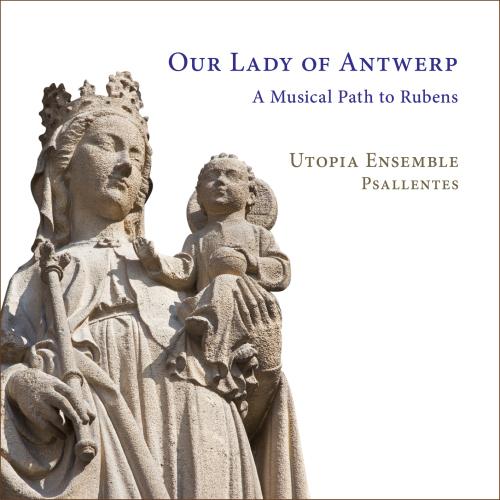
Our Lady of Antwerp. A Musical Path to Rubens Utopia Ensemble & Psallentes
Album info
Album-Release:
2026
HRA-Release:
09.10.2026
Label: Ramée
Genre: Classical
Subgenre: Choral
Artist: Utopia Ensemble & Psallentes
Composer: Jean Pullois (1425-1478), Jacobus Barbireau (1455-1491), Jakob Obrecht (1457-1505), Noel Bauldeweyn (1480-1530), Antoine Barbe (1505-1564), Gerard van Turnhout (1520-1580), Severin Cornet (1530-1582), Noe Faignient (1537-1578), Andreas Pevernage (1543-1591), Matthias Pottier (1553-1629), Peter Philips (1561-1628)
Album including Album cover Booklet (PDF)
- Johannes Pullois: O beata Maria / De madame au biau corps gentil:
- 1 Pullois: O beata Maria / De madame au biau corps gentil 03:35
- Anyonymous: O quam glorifica:
- 2 Anyonymous: O quam glorifica 02:28
- Jacobus Barbireau (1455 - 1491): Missa Virgo parens Christi:
- 3 Barbireau: Missa Virgo parens Christi: I. Kyrie 05:31
- Jacob Obrecht (1457/58 - 1505): Missa Sicut spina rosam:
- 4 Obrecht: Missa Sicut spina rosam: II. Gloria 06:08
- Anyonymous: Cum inducerent / Psalm 102 (103), 3–4 / Inviolata:
- 5 Anyonymous: Cum inducerent / Psalm 102 (103), 3–4 / Inviolata 03:46
- Noel Bauldeweyn: Missa Inviolata:
- 6 Bauldeweyn: Missa Inviolata: III. Credo 08:04
- Anyonymous: Videte miraculum:
- 7 Anyonymous: Videte miraculum 04:02
- Antoine Barbé: Missa Vecy la danse de Barbarie:
- 8 Barbé: Missa Vecy la danse de Barbarie: IV. Sanctus 04:16
- Geert van Turnhout: Mon cœur se recommande à vous:
- 9 Turnhout: Mon cœur se recommande à vous 02:15
- Séverin Cornet: Ave virgo speciosa:
- 10 Cornet: Ave virgo speciosa 03:41
- Anyonymous: Missus est Gabriel / Psalm 102 (103), 1–2 / Iam cum Deo:
- 11 Anyonymous: Missus est Gabriel / Psalm 102 (103), 1–2 / Iam cum Deo 01:59
- Noë Faignient: Susanne un iour:
- 12 Faignient: Susanne un iour 02:28
- Andreas Pevernage: Beata es Virgo Maria:
- 13 Pevernage: Beata es Virgo Maria 06:38
- Matthias Pottier: Missa Sine Nomine:
- 14 Pottier: Missa Sine Nomine: V. Agnus Dei 03:01
- Anyonymous: Ave regina caelorum / Psalm 102 (103) 9–10 / Regali ex progenie / Psalm 102 (103), 21–22:
- 15 Anyonymous: Ave regina caelorum / Psalm 102 (103) 9–10 / Regali ex progenie / Psalm 102 (103), 21–22 03:42
- Peter Philips (1560/61 - 1628): Cantiones Sacræ quinis vocibus:
- 16 Philips: Cantiones Sacræ quinis vocibus: No. 37, Assumpta est Maria 02:37
Info for Our Lady of Antwerp. A Musical Path to Rubens
Antwerp’s collegiate church of Our Lady developed into one of the most important musical centres in the Low Countries over the course of the 15th and 16th centuries. This recording traces the lineage of the directors of music and the singers associated with the church, the later cathedral. Their music illustrates how polyphony evolved from its late mediaeval roots into the early Baroque period. Gregorian chants from the Antwerp tradition are included with the polyphonic works as a reminder of the daily services and their music: there was always singing in the chancel, in the chapels and at the services of brotherhoods and guilds that were spread throughout the day. The name and image of the Virgin Mary were present everywhere, not only in the church’s liturgy but also in the daily life of the city. That same connection remains visible today in the many statues of Mary on façades and street corners — even on the façade of the Town Hall — and in the celebration of Mother’s Day on the Feast of the Assumption. The programme concludes with the early Baroque period, the era in which Peter Paul Rubens was also active. Peter Philips’ Assumpta est Maria shares the same artistic context as Rubens’ monumental Assumption of the Virgin in its place above the high altar of the cathedral of Antwerp.
Utopia Ensemble

Utopia
was founded in 2015. This nascent ensemble blends the voices of 5 Belgian vocalists: Griet De Geyter, Bart Uvyn, Adriaan De Koster, Lieven Termont and Bart Vandeweghe. Over the course of many years, each of these singers have had the pleasure of working with the finest conductors and ensembles in early music: Herreweghe, Paul Dombrecht, Jos Van Veldhoven, and Huelgas Ensemble and Capilla Flamenca. From the start, Utopia has been active on the concert podium with bookings at the Early Music Festival in Warschau and various concerts at the Festival van Vlaanderen in Mechelen. In 2016 Utopia will tour Flanders and the Netherlands with 12 concerts and 3 different programmes. In Antwerp Utopia will be ensemble in residence of the magnificent St. Paul church. The church will not only host regular concerts, but also open its doors for anyone passing by during rehearsals. Utopia’s first CD release is scheduled for April 2016 on Et’cetera Records, featuring the 7 Lamentations of De Morales; a work that has not seen an integral recording for CD before. It is Utopia’s ambition to acquire a secure status in the Early Music scene. Griet De Geyter soprano Bart Uvyn countertenor Adriaan De Koster tenor Lieven Termont baritone Bart Vandewege bass
In 1516, Thomas More published his two book work Utopia, in which he criticized the political and economic England of his time. In this masterpiece he searched for solutions for social problems, problems which are now more relevant than ever.
Almost five hundred years later, five singers with a soft spot for ancient music have joined their voices and created a new ensemble with the very same name: Utopia.
Let's hear what they have to say about it:
"Having Flemish polyphony in our genes, we really want to explore and perform the music of More's time. Polyphony is born when different points of view come together in a single composition. To quote the recent words of the German minister of culture: “We need art and culture, we need bold, inconvenient thinkers and artists. We need the utopias they create, the fantasies that inspire them and the wish for a better world”...
The ensemble Psallentes
was founded in 2000 by singer and conductor Hendrik Vanden Abeele. The ensemble seeks out plainchant and associated polyphony from various historical periods. Particular attention is paid to plainchant of the late Middle Ages and Renaissance.
Gradually, polyphony has taken on an increasingly important role within the work of Psallentes. In 2015, they brought a new CD with the ‘Musique en Wallonie’ label, featuring the music of Antoine de Févin, as found in a unique sixteenth-century manuscript from Tournai that contains both plainchant and polyphony. The same combination of plainchant and polyphony in a single manuscript is also found in the Alamire Manuscript B-Br 215-216 of the Royal Library of Belgium. The women singers of Psallentes performed the intense ‘Mater Dolorosa’ from that manuscript at Laus Polyphoniae Antwerp 2015.
Psallentes is also increasingly enthusiastic about partnering with museum projects. Thus the ensemble recorded the full contents of a sixteenth-century processional for the ‘Begijnhof museum’ in Turnhout (starting in 2015) and worked closely with an exhibition about music in Van Eyck’s altarpiece the ‘Adoration of the Mystic Lamb’ (at the Carmelite convent in Ghent, 2015-2016) and with the new church treasure-museum ‘Teseum’ in Tongeren (2016). They are currently preparing a new project, ‘Salzinnes Saints’, featuring the music from a beautiful sixteenth-century manuscript, held in Halifax, Canada.
Psallentes has given concerts at a great many venues, large and small, throughout Europe – from the intimate Musica Sacra festival in Bever through the Laus Polyphoniae concert series in Antwerp, the Utrecht Early Music festival, the ‘Muziekgebouw aan ’t IJ’ in Amsterdam and the REMA showcase in Valencia to the Vienna Konzerthaus.
Booklet for Our Lady of Antwerp. A Musical Path to Rubens