
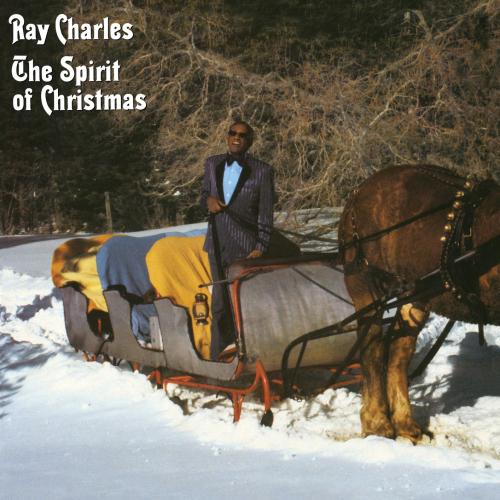
The Spirit Of Christmas (Remastered) Ray Charles
Album info
Album-Release:
1985
HRA-Release:
31.03.2026
Album including Album cover
- 1 What Child Is This (Remastered) 04:59
- 2 The Little Drummer Boy (Remastered) 05:27
- 3 Santa Claus Is Comin' To Town (Remastered) 03:27
- 4 This Time Of The Year (Remastered) 03:14
- 5 Rudolph The Red Nosed Reindeer (Remastered) 04:05
- 6 That Spirit Of Christmas (Remastered) 05:05
- 7 All I Want For Christmas (Remastered) 04:23
- 8 Christmas In My Heart (Remastered) 04:12
- 9 Winter Wonderland (Remastered) 03:31
- 10 Christmas Time (Remastered) 04:39
Info for The Spirit Of Christmas (Remastered)
A soulful album of Christmas and holiday songs, with soul balladry, jazz, horn-lined swing, and choral harmony.
Really, Ray Charles can do no wrong. It’s a truism that holds for this, his first ever Christmas album. Released in 1985, The Spirit of Christmas arrived at a surprisingly late date in Charles’ career for a first anything — he was 55 at the time — but it demonstrates a man who still knew how to control his voice and his fingers like few other performers ever could, even if it’s not the perfect Christmas album it perhaps could have been. Most of the blame for such imperfection lies at the feet of its bookends. “What Child is This” opens the album on a somber note but finishes with an upbeat jazz coda that makes little sense in context with its first two minutes. “Christmas Time” closes and is a soup of heavy reverb effects, fatigued vocals, and syrupy production.
Everything in between, however, is golden. Charles knows when to be lighthearted (“Santa Claus is Coming to Town”) and when to slow it down and reflect (the Christmas Vacation-popularized classic “That Spirit of Christmas”), and “Christmas In My Heart” finds him wailing the end in a way that it’s easy to forget he knows how. This reissue of Charles’ Christmas classic is actually the CD version of a 2008 online-only version of the album, complete with a bonus track of a fantastic, understated “Baby, It’s Cold Outside” performed with Betty Carter in 1961. Altogether, it’s hard to imagine a better album for a dimly lit December evening indoors with eggnog and a roaring fire.
"Really, Ray Charles can do no wrong. It’s a truism that holds for this, his first ever Christmas album. Released in 1985, The Spirit of Christmas arrived at a surprisingly late date in Charles’ career for a first anything — he was 55 at the time — but it demonstrates a man who still knew how to control his voice and his fingers like few other performers ever could, even if it’s not the perfect Christmas album it perhaps could have been. Most of the blame for such imperfection lies at the feet of its bookends. “What Child is This” opens the album on a somber note but finishes with an upbeat jazz coda that makes little sense in context with its first two minutes. “Christmas Time” closes and is a soup of heavy reverb effects, fatigued vocals, and syrupy production.
Everything in between, however, is golden. Charles knows when to be lighthearted (“Santa Claus is Coming to Town”) and when to slow it down and reflect (the Christmas Vacation-popularized classic “That Spirit of Christmas”), and “Christmas In My Heart” finds him wailing the end in a way that it’s easy to forget he knows how."
All band tracks but one were done - before the end of the summer while still on tour - with Ray's contemporary band, including Johnny Coles, who was a regular member on this tour from the beginning in April to and including the Fall of 1984, and who did a substantial portion of the trumpet solos.
The one exception that wasn't backed by the band, was The Little Drummer Boy, which was recorded "off season" (i.e. in a hiatus between tours, maybe in early 1985 before Ray hit the road again) with a few LA session musicians, amongst whom James Gadson, who also contributed to a few of the other tracks. As a special guest (and one of the few musicians who were credited in the album's liner notes), Freddie Hubbard** took care of some of the trumpet solos.
James Polk recalls that Rudy Johnson and Clifford Solomon laid down some saxophone solos. All solos and e.g. the bass tracks (by Roger W. Hines) were recorded separately, outside the group sessions, as overdubs.
Guitarist Jeff Pevar wrote: "In the winter of 1984, just after joining the RC Orchestra, I was invited by Ray to fly out to his recording studio in Los Angeles to play guitar on some songs he was working on in his studio at the time. We spent a couple days working together, just the 2 of us. On [Rudolph The Red Nosed Reindeer], Ray wanted me to play blues guitar and asked me to just play whatever I felt. After I overdubbed guitar to the song we then rewound the tape (no pro tools back then) and we listened back to the work and he either said something like... 'Oh man, I LOVE that there!' ....or.... he would sing a blues guitar melody that he would want me to play to replace what I had played."
Ray Charles, vocals, piano, synthesizer
Ray Charles Orchestra:
Mark Curry, trumpet
Jim Seeley, trumpet
Robbie Kwock, trumpet
Jeff Kaye, trumpet
Johnny Coles, trumpet
Mayo Tiana, trombone
John Boice, trombone
Dan Weinstein, trombone
Dana Hughes, trombone
Clifford Solomon, saxophone
Brian Mitchell, saxophone
Rudy Johnson, saxophone
Ricky Woodard, saxophone
Louis Van Taylor, saxophone
James Polk, piano, keyboards
Roger Hines, bass
Kevin Turner, guitar
Calvin Keys, guitar
Rick Kirkland, drums
Additional musicians:
Freddie Hubbard, trumpet
Jeff Pevar, guitar
James Gadson, drums
The Raelettes, backing vocals
Digitally remastered
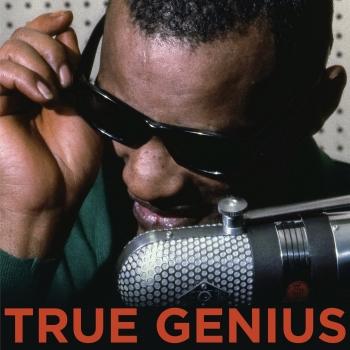
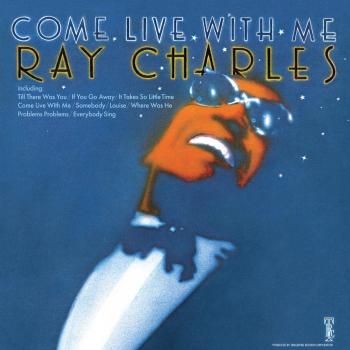
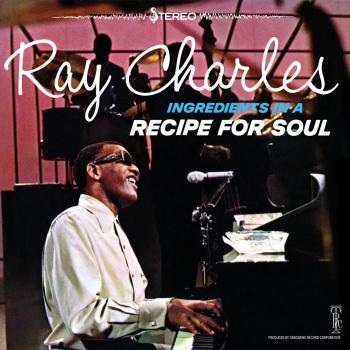
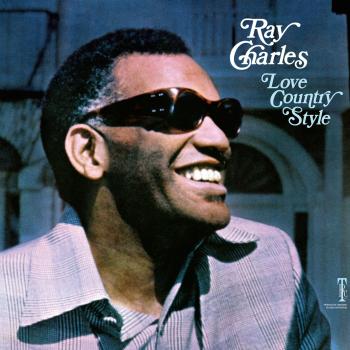
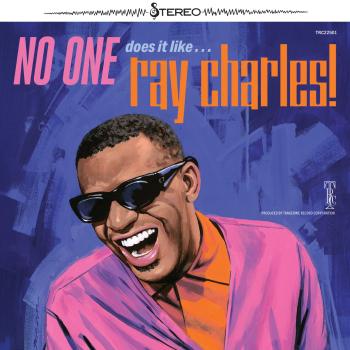


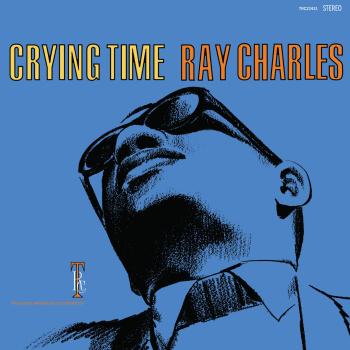

Ray Charles
The name Ray Charles is on a Star on Hollywood Boulevard’s Walk of Fame. The name Ray Charles designates a superstar worldwide. His bronze bust is enshrined in the Playboy Jazz Hall of Fame. There is the bronze medallion that was cast and presented to him by the French Republic on behalf of the French people. In just about every Hall of Fame that has anything to do with music, be it Rhythm & Blues, Jazz, Rock & Roll, Gospel or Country & Western, Ray’s name is very prominently displayed. There are many awards given to him in the foregoing categories as proof.
Probably the strongest element in Ray Charles’ life, and the most concentrated driving force, was music. Ray often said, “I was born with music inside me. That’s the only explanation I know.”
Ray Charles was not born blind. In fact, it took almost seven years for him to lose his sight in its entirety, which means he had seven years to see the joy and sadness of this big wonderful world – a world he would never see again. As a seven year old child, in searching for light, he stared at the sun continuously, thereby eliminating all chances of the modern-day miracle, cornea transplants – a surgery unheard of in 1937.
Perhaps the reason that Ray Charles made music his mistress and fell madly in love with the lady is that music was a natural to him. Ray sat at a piano and the music began; he opened his mouth and the lyrics began. He was in absolute control.
But the rest of his life was not quite so simple. Ray was born at the very beginning of the Great Depression – a depression that affected every civilized country in the world. Ray was born in 1930 in Albany, Georgia, the same year that another Georgia native by the name of Hoagy Carmichael, was already making his mark on the world. In 1930, the year of Ray’s birth, Hoagy recorded a song that became an all-time classic and remains so to this day; a song titled “Stardust.” It’s ironic that these two Georgia natives would someday cross paths again, as they did 30 years later when Ray Charles was asked by the State of Georgia to perform, in the Georgia Legislative Chambers, the song they had selected as their state song. That song was Ray’s version of “Georgia,” written by Hoagy Carmichael. Hoagy, who unfortunately was too ill to attend the event, was listening via telephone/satellite tie-up.
Ray’s mother and father, Aretha and Bailey, were “no-nonsense” parents. Even after Ray lost his sight, his mother continued to give him chores at home, in the rural area in which they lived, such as chopping wood for the wood burning stove in the kitchen in order for them to prepare their meals. Chores such as this often brought complaints from the neighbors, which were met with stern words from Mrs. Robinson. She told them her son was blind, not stupid, and he must continue to learn to do things, not only for himself, but for others as well. Unfortunately, Ray lost the guidance of his mother and the counseling of his father at a very young age. At 15 years old, Ray Charles was an orphan, but he still managed to make his way in this world under very trying conditions; living in the South and being of African-American heritage, plus being blind and an orphan.
Ray refused to roll over and play dead. Instead he continued his education in St. Augustine, at Florida’s State School for the Deaf and Blind. A few years later, Ray decided to move. His choice was Seattle, Washington. It was in Seattle that Ray recorded his first record. It was also in Seattle that the seed was planted for a lifelong friendship with Quincy Jones. More information please visit the Ray Charles homepage.
This album contains no booklet.