

[].
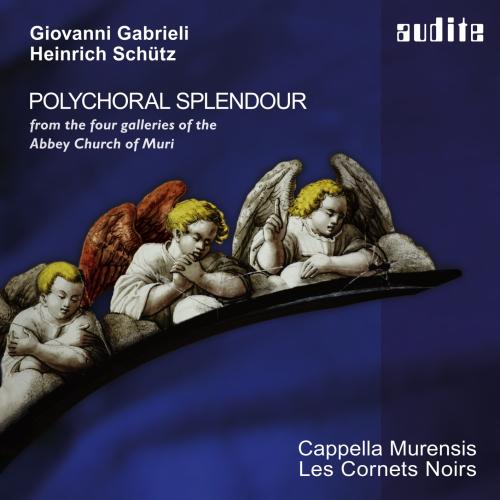
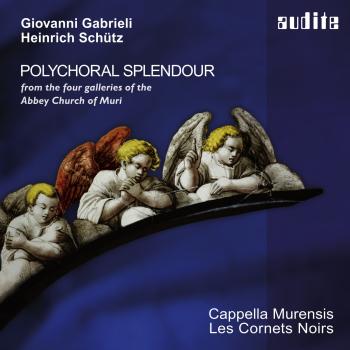
Polychoral Splendour (Music by Giovanni Gabrieli and Heinrich Schütz from the four galleries of the Abbey Church of Muri) Cappella Murensis & Les Cornets Noirs
Album info
Album-Release:
2012
HRA-Release:
23.03.2026
Label: audite Musikproduktion
Genre: Classical
Subgenre: Choral
Artist: Cappella Murensis & Les Cornets Noirs
Composer: Heinrich Schütz (1585-1672), Giovanni Gabrieli (1557-1612)
Album including Album cover
- Heinrich Schütz (1585 - 1672): Psalmen Davids für 2 Favoritchöre, 2 Capellchöre und Basso Continuo:
- 1 Schütz: Psalmen Davids für 2 Favoritchöre, 2 Capellchöre und Basso Continuo: Warum toben die Heiden, SWV 23 04:36
- Giovanni Gabrieli (1557 - 1612): Sacrae Symphoniae:
- 2 Gabrieli: Sacrae Symphoniae: Canzon primi toni a 8, C 170 03:50
- Heinrich Schütz: Symphoniarum sacrarum tertia Pars:
- 3 Schütz: Symphoniarum sacrarum tertia Pars: Saul, Saul, was verfolgst du mich?, SWV 415 02:38
- Giovanni Gabrieli: Sacrae Symphoniae:
- 4 Gabrieli: Sacrae Symphoniae: Canzon quarti toni a 15, C 185 04:36
- Heinrich Schütz: Symphoniarum sacrarum tertia Pars:
- 5 Schütz: Symphoniarum sacrarum tertia Pars: Komm, Heiliger Geist, SWV 417 06:50
- Giovanni Gabrieli: Canzoni et Sonate:
- 6 Gabrieli: Canzoni et Sonate: Canzon VIII a 8, C 202 06:02
- Heinrich Schütz: Psalmen Davids für 2 Favoritchöre, 2 Capellchöre und Basso Continuo:
- 7 Schütz: Psalmen Davids für 2 Favoritchöre, 2 Capellchöre und Basso Continuo: Ich danke dem Herrn von ganzem Herzen, SVW 34 06:12
- Giovanni Gabrieli: Canzoni et Sonate:
- 8 Gabrieli: Canzoni et Sonate: Sonata XVIII a 14, C 211 06:39
- Heinrich Schütz: Symphoniarum sacrarum tertia Pars:
- 9 Schütz: Symphoniarum sacrarum tertia Pars: Vater unser, der du bist im Himmel, SWV 411 06:12
- Giovanni Gabrieli: Sacrae Symphoniae:
- 10 Gabrieli: Sacrae Symphoniae: Canzon in echo duodecimi toni a 10, C 180 04:37
- Heinrich Schütz: Psalmen Davids für 2 Favoritchöre, 2 Capellchöre und Basso Continuo:
- 11 Schütz: Psalmen Davids für 2 Favoritchöre, 2 Capellchöre und Basso Continuo: Zion spricht: Der Herr hat mich verlassen, SWV 46 05:49
- Giovanni Gabrieli: Sacrae Symphoniae:
- 12 Gabrieli: Sacrae Symphoniae: Canzon septimi toni a 8, C 171 04:36
- Heinrich Schütz: Psalmen Davids für 2 Favoritchöre, 2 Capellchöre und Basso Continuo:
- 13 Schütz: Psalmen Davids für 2 Favoritchöre, 2 Capellchöre und Basso Continuo: Alleluja! Lobet den Herrn, SWV 38 10:18
- 14 Schütz: Psalmen Davids für 2 Favoritchöre, 2 Capellchöre und Basso Continuo: Ach Herr, straf mich nicht in deinem Zorn, SWV 24 05:07
- 15 Schütz: Psalmen Davids für 2 Favoritchöre, 2 Capellchöre und Basso Continuo: Wohl dem, der den Herren fürchtet, SWV 30 05:38
- Symphoniarum sacrarum tertia pars:
- 16 Schütz: Symphoniarum sacrarum tertia pars: Siehe, es erschien der Engel des Herren Joseph im Traum, SWV 403 04:41
Info for Polychoral Splendour (Music by Giovanni Gabrieli and Heinrich Schütz from the four galleries of the Abbey Church of Muri)
With two-, three- and four-choir works by Giovanni Gabrieli and Heinrich Schütz, the Cappella Murensis and the ensemble Les Cornets Noirs make perfect use of the four galleries in the Abbey Church of Muri: voices and instruments blend with the historic Bossart organs to produce a unique sound.
The young Heinrich Schütz's four-year sojourn with Giovanni Gabrieli proved to be one of the most fruitful educational journeys to Italy undertaken by German musicians, artists and writers. Following his return, Schütz presented his Psalms of David in 1619: an impressive result of his encounter with the Italian musical style. These Teutsche Psalmen auf Italienische Manier ("German Psalms in the Italian Manner") are consistently based on the polychoral style with which Schütz had become acquainted in the Venetian tradition of cori spezzati. As first organist of St Mark's, Venice, Gabrieli included in his compositions the architecture of this ecclesiastical building in a unique way, placing the singers and instrumentalists, who were divided into as many as four choirs, in facing galleries, thus achieving remarkable sonic and spatial effects.
On this recording the Cappella Murensis and the ensemble Les Cornets Noirs make use of the four galleries in the Abbey Church at Muri, following the historic model: in the works for two, three and four choirs, voices and instruments blend with a total of four continuo organs, producing a unique sound. The inclusion of the two large historic Bossart organs ("Epistle" and "Gospel Organ") as continuo instruments creates an additional dynamic palette. Rather than being constantly present as soloists, the vocal parts are often integrated, as instruments, into the overall sound, thus appearing all the more prominent in solo passages. This supports the compelling contrast between expansive tutti and concertante sections characteristic of this music.
With magnificent Sonatas and Canzonas by Giovanni Gabrieli, Les Cornets Noirs, led by the cornettists Gebhard David and Bork-Frithjof Smith, once more showcase themselves as one of the leading European ensembles in the field of early baroque music.
With Italy in mind, the abbots and master builders designed the octagonal nave of the Abbey Church at Muri with its four galleries especially for polychoral music-making. The Cappella Murensis under its founder Johannes Strobl and Les Cornets Noirs regularly perform here using several choirs spaced widely apart.
Cappella Murensis
Les Cornets Noirs
Johannes Strobl, director
Cappella Murensis
The Cappella Murensis was founded by Johannes Strobl in 2002 as the professional vocal ensemble of the Abbey Church of Muri. According to the musical task in hand, the Cappella Murensis performs as an ensemble of vocal soloists, a chamber choir, or a Gregorian choir. One of the main focuses of Johannes Strobl and the Cappella Murensis is church music of the 16th to the 18th centuries, which is particularly suited to performance in the Abbey Church of Muri. In this period, the contribution of his- torical organs belongs of course de facto to the musical practice: alongside all forms of polychorality, particular attention is devoted to the connection between organ music and Gregorian chant that forms part of the Benedictine heritage of the Abbey Church of Muri.
With the Cappella Murensis, Johannes Strobl regularly organises performances of liturgical compositions that have been re-discovered in Swiss monasteries, which are also documented in radio recordings. Thus the ensemble has performed at the Festi- val international des musiques sacreés in Fribourg, at the International Bach Festival in Schaffhausen, in the banqueting hall of the monastery at Einsiedeln, in St. Gallen Cathedral, and at the Early Music Festival in Utrecht.
In collaboration with Thilo Hirsch and the ensemble arcimboldo, the Cappella Murensis has previously issued a recording of Johann Valentin Rathgeber’s “Missa solennis in D” op. 12/12 with audite. A second SACD, “Polychoral Splendour”, with polychoral works by Heinrich Schütz and Giovanni Gabrieli, was awarded the distinc- tion of the International Classical Music Award 2013.
Les Cornets Noirs
In recent years the instrumental ensemble Les Cornets Noirs, which specialises in Italian and German Early Baroque music, has made a name for itself internationally. Founded in 1997 by Gebhard David and Bork-Frithjof Smith, the main interest of the group lies in solo and ensemble literature for the cornett (It. cornetto, Fr. cornet – also called “black cornett” because of its leather covering), which experienced its hey-day from the middle of the 16th to the late 17th century north and south of the Alps.
Les Cornets Noirs were prize winners in the concours musica antiqua at the Festival van Vlaanderen Brugge 2000. Since then, the ensemble has performed at festivals in Switzerland, Austria, Germany, the Czech Republic, Poland, France, Luxemburg, Italy, and Portugal, both with their own programmes and in collaboration with vocal groups for the performance of large-scale Early Baroque works by Giovanni Gabrieli, Heinrich Schütz, Claudio Monteverdi, Georg Muffat, Heinrich Ignaz Franz Biber, and their contemporaries.
Les Cornets Noirs have also already issued two successful recordings with audite („Echo & Risposta“ and „Polychoral Splendour“).
Johannes Strobl
The Austrian-born musician Johannes Strobl received his rst piano and organ lessons at the music school of Spittal an der Drau with Hermann Zeyß. He graduated from the Hochschule für Musik und Darstellende Kunst “Mozarteum” in Salzburg with Heribert Metzger and was awarded distinctions in both his teaching and soloist di- ploma in organ and his advanced degree in Catholic Church Music. This was followed by comprehensive studies in Early Music at the Schola Cantorum Basiliensis with Jean-Claude Zehnder (organ), Jörg-Andreas Bötticher (harpsichord), Jesper Chris- tensen ( gured bass) and Rudolf Lutz (improvisation), and additional masterclasses with Michael Radulescu, Luigi Ferdinando Tagliavini, Harald Vogel, Almut Rössler and James David Christie.
Johannes Strobl was a prize winner at the Paul Hofhaimer competition in Innsbruck in 1998. His musical activities as a soloist and ensemble player have taken him to many European countries and further a eld to Israel, Japan, the US, Brasil, and Argentina.
Since 2001, Johannes Strobl has been employed as Director of Music of the Catholic parish of Muri in the Swiss canton of Aargau. In this role, he oversees the important historical organs of the church of the former Benedictine monastery and is artistic director of a distinguished concert series. He also teaches Improvisation and Liturgical Organ Playing at the Hochschule Luzern in the music faculty’s department of church music.
This album contains no booklet.