

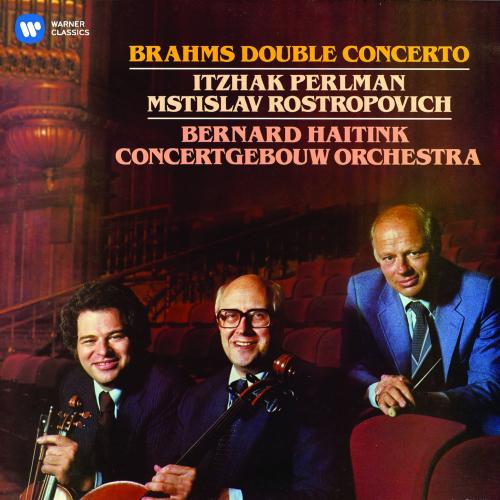
Brahms: Double Concerto, Op. 102 Itzhak Perlman, Mstislav Rostropovich, Concertgebouworkest & Bernard Haitink
Album Info
Album Veröffentlichung:
2017
HRA-Veröffentlichung:
16.10.2026
Label: Warner Classics
Genre: Classical
Subgenre: Concertos
Interpret: Itzhak Perlman, Mstislav Rostropovich, Concertgebouworkest & Bernard Haitink
Komponist: Johannes Brahms (1833-1897)
Das Album enthält Albumcover
Entschuldigen Sie bitte!
Sehr geehrter HIGHRESAUDIO Besucher,
leider kann das Album zurzeit aufgrund von Länder- und Lizenzbeschränkungen nicht gekauft werden oder uns liegt der offizielle Veröffentlichungstermin für Ihr Land noch nicht vor. Wir aktualisieren unsere Veröffentlichungstermine ein- bis zweimal die Woche. Bitte schauen Sie ab und zu mal wieder rein.
Wir empfehlen Ihnen das Album auf Ihre Merkliste zu setzen.
Wir bedanken uns für Ihr Verständnis und Ihre Geduld.
Ihr, HIGHRESAUDIO
- Johannes Brahms (1833-1897): Double Concerto for Violin and Cello in A Minor, Op. 102:
- 1 Brahms: Double Concerto for Violin and Cello in A Minor, Op. 102: I. Allegro 16:53
- 2 Brahms: Double Concerto for Violin and Cello in A Minor, Op. 102: II. Andante 07:45
- 3 Brahms: Double Concerto for Violin and Cello in A Minor, Op. 102: III. Vivace non troppo 08:41
Info zu Brahms: Double Concerto, Op. 102
Träume befreien uns von den Zwängen der Realität und ermöglichen es uns, nach dem Ideal zu streben. Klassische Klassiker – ich stelle mir vor, dass Komponisten oft von wundersamen neuen Instrumenten träumen müssen, die die klanglichen Fesseln ihrer Zeit überwinden, um ihre weitreichendsten Visionen zu verwirklichen. Im 20. Jahrhundert gelang es Charles Ives, Harry Partch, John Cage und anderen, solchen Impulsen nachzugehen, doch in der Romantik war es Johannes Brahms (1833–1897) – ironischerweise einer der konservativsten Vertreter seiner Zeit –, der mit seinem 1887 entstandenen „Doppel“- Konzert für Violine und Cello, Op. 102, den Weg wies.
Durch die Kombination von Violine und Cello für die Solopassagen seines letzten Orchesterwerks gelang es Brahms, ein „Super“-Streichinstrument zu schaffen, dessen Klangfülle und Tonumfang keines der beiden Instrumente allein bieten konnte. Man denke nur an den ersten gemeinsamen Auftritt der beiden Instrumente in Takt 46 des Eröffnungssatzes, wo sie in einer einzigen Phrase sanft von der obersten Note der fünften Lage auf der höchsten Saite der Violine zur tiefsten Note des Cellos gleiten und dann wieder hin und her, als würde Brahms stolz seine neue Erfindung präsentieren (doch typisch für einen Komponisten, der fest in den Mitteln der Vergangenheit verankert war, bestand seine Schöpfung aus zwei unveränderten traditionellen Instrumenten).
Doch das Doppelkonzert entstand nicht aus Brahms’ Fantasien, sondern vielmehr aus der harten Realität einer dissonanten Entwicklung in seinem privaten und beruflichen Leben. Sein engster musikalischer Freund war Joseph Joachim gewesen, der herausragende Geiger jener Zeit, der viele seiner Kompositionen inspiriert hatte, dem Brahms sein einziges Violinkonzert gewidmet hatte und auf dessen Rat sich Brahms stets verließ. Doch ihre Verbindung zerbrach während des Scheidungsverfahrens von Joachims Frau, nachdem sie einen privaten Unterstützungsbrief offenlegte, den Brahms geschrieben hatte, um Joachims Vorwurf einer Affäre mit Brahms’ Verleger zu entkräften. Infolgedessen fühlte sich der Geiger betrogen, und Brahms sah sich mit dem Verlust seines engsten musikalischen Weggefährten konfrontiert.
Robert Hausmann, der Cellist in Joachims Quartett, hatte Brahms gebeten, ein Konzert für ihn zu schreiben, und so ergriff Brahms diese Gelegenheit, um Joachim zurückzugewinnen. Richard Freed ist der Ansicht, dass die direkte Geste eines neuen Violinkonzerts Joachim in Verlegenheit gebracht oder dazu veranlasst hätte, es abzulehnen, und so griff Brahms die Idee auf, beide Instrumente in einem einzigen Konzert zu vereinen. (James Goodfriend vermutet zudem, dass Brahms von der natürlichen Schönheit der Region um den Thonsee in der Schweiz inspiriert wurde, wo er seinen Sommerurlaub verbrachte – ebenso wie von den zahlreichen Biergärten, die Brahms lobte.) Joseph Joachim Clara Schumann, die Brahms nach dem Tod ihres Mannes, des Komponisten Robert, weiterhin nahestand, bezeichnete das Ergebnis als „Versöhnungswerk“, und tatsächlich baute Brahms sogar ein Thema aus einem von Joachims Lieblingswerken ein, einem Violinkonzert von Viotti. Brahms schrieb Joachim eher zaghaft eine formelle Postkarte, um die Möglichkeit seines Vorhabens anzusprechen, und bat ihn dann, nachdem Joachim zugestimmt hatte, um Rat, ob die vorläufigen Skizzen spielbar seien. (Joachim schlug zwar umfangreiche Überarbeitungen vor, von denen Brahms jedoch die meisten letztendlich außer Acht ließ.) Auf jeden Fall entfaltete das neue Werk die beabsichtigte Wirkung – Brahms, Hausmann und Joachim trafen sich in Claras Haus, um das Doppelkonzert einzustudieren, und gaben am 21. September 1887 eine private Aufführung im nahegelegenen Casino von Baden-Baden. Die öffentliche Uraufführung folgte am 18. Oktober, und das Werk wurde in dieser Konzertsaison noch mehrere Male aufgeführt.
Offensichtlich hatte das Doppelkonzert für Brahms eine große persönliche Bedeutung – obwohl es keine formelle Widmung enthielt, schrieb er auf die Autographpartitur, die er Joachim überreichte: „Dem, für den es geschrieben ist“, und sagte nach seiner Rückkehr nach Wien, er wisse nun, was ihm in den letzten Jahren in seinem Leben gefehlt habe – der Klang von Joachims Violine. Doch Joachim war kaum besänftigt und meinte, das Konzert gehöre nicht zu Brahms’ inspiriertesten Werken; er fügte hinzu (vielleicht mit mehr als nur einem Hauch von anhaltendem persönlichem Groll und Ego), dass die Solopartien mehr Brillanz benötigten. Auch Clara war unbeeindruckt: „Ich glaube nicht, dass das Konzert eine Zukunft hat. Es weist nirgendwo jene Wärme und Frische auf, die in seinen Werken so oft zu finden sind.“
„Vielleicht symbolisch für die grundlegende Faszination des Werks selbst, bietet diese Aufnahme eine überzeugende Balance aus Zurückhaltung und Gefühl. Haitink, der zu den objektivsten Dirigenten zählt, und das Concertgebouw-Orchester, das für seine klangliche Eleganz bekannt ist, schaffen eine relativ langsame Grundlage, die den Solisten genügend Spielraum lässt, um gerade so viel Tiefe und Akzent zu vermitteln, dass ein Gefühl irrationaler Unbeständigkeit vermieden wird, und gerade so viel Charme – und sogar gelegentlich ein bisschen Kitsch –, um uns zu fesseln, ohne aufdringlich zu wirken. David Oistrach und Mstislav Rostropowitsch spielen das Doppelkonzert unter der Leitung von George Szell (Angel-LP-Cover) Itzhak Perlman und Mstislav Rostropovich spielen das Doppelkonzert unter der Leitung von Bernard Haitink (EMI-CD-Cover) Ein ähnliches Schema prägt das Finale, da die persönlichen Akzente der Solisten die Regelmäßigkeit der Orchesterpassagen stets beleben und schließlich mit einem gewaltigen Paukenwirbel triumphierend enden. Eine Aufnahme des Doppelkonzerts von Haitink mit dem Concertgebouw-Orchester aus dem Jahr 1970 mit Henryk Szeryng und János Starker (Philips-LP) weist nahezu identische Spielzeiten auf, doch die engere Übereinstimmung zwischen den Temperamenten der Solisten und des Orchesters erweist sich als weit weniger fesselnd und scheint den Reiz der Neuaufnahme zu schmälern.“
Itzhak Perlman, Violine
Mstislav Rostropovich, Cello
Concertgebouw-Orchester
Bernard Haitink, Dirigent
Digital remastered
Itzhak Perlman
was born in Tel Aviv on 31st August 1945 to a family of Polish origin. He was drawn to the violin from the age of three, but when he was four he contracted polio, losing the use of his legs. Despite his handicap, he began learning the violin a year later, and his first teacher was a café violinist. Very soon, he joined the Tel Aviv Music Academy where he studied for eight years with Rivka Goldgart, a teacher of Russian origin.
At the age of ten, he auditioned for Isaac Stern, who advised him to continue his studies in the United States. He gave his first concerts in Tel Aviv and in 1958 was noticed by the American television presenter Ed Sullivan who invited him on his famous show. America marvelled at the young Itzhak playing the finale of Mendelssohn’s Concerto and Rimsky-Korsakov's Flight of the Bumblebee. A tour of the States with 'Sullivan’s Caravan of Stars' followed.
Perlman settled in New York with his mother and joined the Juilliard School where he worked with Ivan Galamian and his assistant Dorothy DeLay for several years. Under their influence, he abandoned his 'Russian' bow hold in favour of the Franco-Belgian bow hold developed by Lucien Capet. On 5th March 1963, he made his American debut with the National Orchestra Association of New York and, the same year, he performed at Carnegie Hall.
In 1964, Itzhak Perlman won first prize in the Leventritt Competition, which allowed him to perform with the greatest American orchestras, including the New York Philharmonic. Encouraged by Isaac Stern and guided by the famous American agent Sol Hurok, his career was launched and the same year he made his first record, of Tchaikovsky’s Violin Concerto. The following year, he gave tours throughout the States and in 1966-1967 he gave his first European tours. He was immediately recognised as one of the most brilliant violinists of his generation. He played chamber music with the great performers of his day, such as pianist Daniel Barenboim, violinist and violist Pinchas Zukerman, and cellists Jacqueline Du Pré and Lynn Harrell, with whom he developed lifelong friendships. He also formed a duo with pianist Vladimir Ashkenazy, with whom he recording more sonatas in the repertoire than with any other partner.
He remains one of the world’s most popular musicians thanks to his phenomenal talent, his natural ease and his radiant sound, but also due to his generous temperament and his warm contact with the public. He often appears on American television, both as performer and commentator.
Itzhak Perlman’s huge repertoire ranges from the Baroque to the contemporary, although he has a particular penchant for the Romantic era. He also excels in other forms of music such as jazz or ragtime, playing with his friend André Previn or with Oscar Peterson. Like his eminent predecessor Mischa Elman with Caruso, he has recorded duos of popular melodies with the great tenor Placido Domingo. He also has a deep affinity for the Klezmer violin of the Jewish folklore tradition.
Since 1975, Itzhak Perlman has regularly given master classes at Brooklyn College in New York. He has also organised various initiatives worldwide for people with physical disabilities. He has premiered many works dedicated to him by American composers such as Earl Kim (1979) and Robert Starer (1981). In recent years, he has devoted his time to conducting orchestras, taking the post of principal guest conductor with the Detroit Symphony Orchestra and acting as musical advisor for the Saint Louis Symphony Orchestra. His ever-growing discography is one of the most substantial ever recorded by a violinist.
Mstislav Rostropovich
is internationally acclaimed and acknowledged as one of the world's greatest living cellists. He has given countless memorable performances and has inspired the world's leading composers to enlarge and enrich the standard cello repertoire with works specially composed for and dedicated to him. These include works by Britten, Bliss, Khachaturian, Lutoslawski, Prokofiev and Shostakovich. Rostropovich was soloist in the premieres of Prokofiev's second Cello Concerto in 1952, Shostakovich's two Cello Concertos in 1959 and 1966, Britten's Cello Symphony in 1964 and Bliss's Cello Concerto in 1970. Many other works have been written for him and today his repertoire includes more than 50 concertos, ranging from the baroque, through the classical and romantic periods, to the avant-garde. As a cellist, Rostropovich is noted for his commanding technique and intense, visionary playing.
Rostropovich was born in Baku, Azerbaijan in 1927. At the age of four he started piano lessons with his mother and shortly afterwards began to study the cello with his father. He continued under his father's tuition at the Central Music School in Moscow and then went on to the Moscow Conservatoire, where in addition to his cello and piano studies he began to conduct. He made his public debut as a cellist in 1942 at the age of 15 and was immediately recognized as a potentially great artist. When the war ended his reputation soon spread outside the USSR, principally through his recordings, and when he began touring in the West it was soon apparent that in Rostropovich the world had a natural successor to the great Pablo Casals, who had reigned as the supreme cellist for more than half a century.
Rostropovich has also won outstanding acclaim as a conductor, appearing with most of the world's leading orchestras, as well as conducting and recording many operas, including Queen of Spades, Eugene Onegin, Lady Macbeth of Mtsensk and Tosca. Since 1977 he has been Music Director of the National Symphony Orchestra of Washington. He appears regularly in the UK with the London Symphony Orchestra (he made his UK conducting debut in 1974) and with other leading British orchestras. The London Symphony Orchestra have forged close links with Rostropovich through major festivals which have made an enormous impact on London's musical life. Rostropovich was a close friend of Sergei Prokofiev and was the inspiration behind the LSO's Sergei Prokofiev: The Centenary Festival 1991, featuring orchestral and chamber music, and the world premiere of a cello fugue dedicated to Rostropovich. In 1993 Rostropovich led the Festival of Britten with the LSO, appearing both as conductor and soloist. Other events with the LSO have included Rostropovich's 60th Birthday series in 1987 and Shostakovich: Music from the Flames in 1988. Both on the cello and on the conductor's rostrum, Rostropovich is considered one of the leading interpreters of the music of Shostakovich (with whom he studied composition), Britten, and Prokofiev.
Mstislav Rostropovich is one of the world's most outspoken defenders of human and artistic freedoms. In 1974, after a period of four years during which the writer Solzhenitsyn resided in their home, Rostropovich and Vishnevskaya left the Soviet Union at their own request. Since then he has devoted much time and has given numerous performances to support humanitarian efforts around the world. In 1990, after an absence of 16 years, he made a triumphant return to the Soviet Union with the National Symphony Orchestra of Washington, giving concerts in Washington and Leningrad to enormous acclaim. During the coup of August 1991 the strength of his attachment to his native Russia compelled him to fly, without a visa, to Moscow, to spend those momentous days in the Russian Parliament building and on the streets, where he was hailed as a national hero.
Mstislav Rostropovich holds over 40 honorary degrees and over 30 different nations have bestowed more than 130 major awards and decorations upon him. These include the German Order of Merit, the Gold Medal of the Royal Philharmonic Society, the Lenin Prize, the Annual Award of the League of Human Rights, the ÆPreamium Imperiale from the Japan Arts Association and the Knight Commander of the Most Excellent Order of the British Empire. (Source: Cello.org)
Dieses Album enthält kein Booklet